Venetian plaster · hand-applied
Marmorino Venetian Plaster
Bellart Decor installs Marmorino Venetian plaster across Ireland, from our base in Kilcullen, Co. Kildare. Whole rooms, hallways, stairwells, ceilings, chimney breasts and bathroom walls, over sound plasterboard, old paint or tiles. It is slaked lime loaded with marble or stone dust, burnished to a matte or satin sheen, a millimetre or two thick. The most forgiving of the three finishes we apply, and the one that patches years later without the repair showing. Also sold as stucco marmorino or Marmorino polished plaster.

Soft matte lime finish
Breathes on solid walls
Knocks repair invisibly
What our clients say
“I can't recommend Haris enough. He's very skilled, respectful and trustful. He was always on time and worked weekends to finish a project which was delayed by another contractor. I am delighted with the microcement in my bathroom. I will choose Haris again.”
“I couldn't recommend Harris more highly. Such a lovely person, extremely knowledgeable, particular and punctual. Came onto a job that was left in a mess by …”
“We had the pleasure of working with Haris on a microcement project, and we couldn't be happier with the results. His passion for his craft is evident in every …”
What is Marmorino plaster?
Slaked lime. No acrylic, no resin.
Marble or stone dust, coarser than in the polished finishes. That coarseness is the point: it gives grain and stops the surface going glassy under the trowel.
Pigment in the lime, not on it. A scratch shows the same colour underneath.
Two or three thin ones, each worked with a steel trowel then compressed as it sets.
A millimetre or two in total. A finish, not a render and not a levelling coat. It follows the wall it is put on.
Lime takes carbon dioxide out of the air and turns into calcium carbonate, so it keeps hardening for years instead of degrading like a paint film.
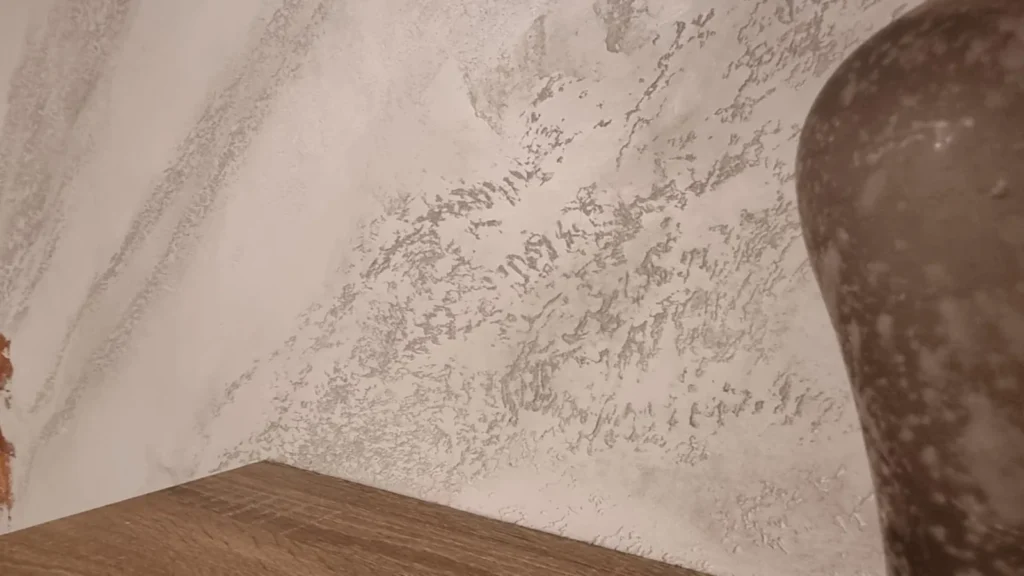
What it looks like on a real wall
Three things people notice, and they only show up in person.
The layers read through each other, so the wall is lighter near a window and deeper away from it, and the shade shifts through the day. That is the finish working, not a patchy job.
A faint tooth under your hand, like honed stone. It does not catch dust the way a heavy textured plaster does.
Between chalk-matte and soft satin, depending on how hard it is burnished and whether it is waxed. It does not reflect the room back at you, which in a low-ceilinged Irish sitting room is usually the right call.
Read more +
If you want a wall that looks identical from every angle, you want paint.
Marmorino or polished marble?
The question we are asked most. Most people who show us a photo of a mirror-gloss wall choose Marmorino once they have seen both in the flesh.
Marmorino
Polished marble
Sheen
Matte to soft satin
Satin to near-mirror
Surface
Slight grain, stone-like
Smooth and closed
Layers
Two or three
Several more, each burnished harder
Demands on the wall behind
Tolerant: a small imperfection reads as part of the finish
Unforgiving: every bump and taped joint shows
Best light
Anything, including a north-facing room
Rewards good light, punishes a window that rakes along the wall
Repairs
A patch can usually be blended invisibly
A patch shows; we would redo the panel to the nearest corner
Marks and fingerprints
Barely shows them
Shows them on a dark colour
Labour, and so price
Lower
Higher: the same wall can take twice the hours
Suits
Whole rooms, hallways, ceilings, older houses, family homes
Feature walls, reception areas, powder rooms
Rule of thumb we use on site: Marmorino for surfaces you live against, polished marble for surfaces you look at. A stairwell with a buggy going up it gets Marmorino. The wall behind a hotel reception desk gets polished.
Which finish for which wall
Still between two? Ask for both on one panel. A minute in your own room settles what a week of photographs will not.
A whole room rather than one wall; a wall in daily use; a north-facing or dark room; a substrate that is sound but not perfectly flat; a finish you can patch years later.
You want visible texture, pores and veining, usually on one feature wall or a chimney breast.
The wall is flat, well lit, and looked at rather than leaned on: a powder room, a feature panel, a reception area. Costs more in hours, not material.
It is a floor, a worktop or the inside of a shower.
Where Marmorino works best
The only one of the three we would routinely put on all four walls of a living room or bedroom. The low sheen keeps the room from bouncing light around.
Hard-wearing, and a knock leaves a mark that can be blended rather than a scar in a gloss.
Slower overhead, but a matte ceiling does not fight the light fittings. → Plaster walls and ceilings
Lime is vapour-open, so it is a better neighbour than a plastic-based paint on a wall that needs to breathe.
No joints, no cut lines, and it goes round a curve without a seam → Kitchens and fireplaces
Steam is fine. Standing water is not. → Venetian plaster bathrooms
Restaurants, bars and hotel corridors, where walls get touched all day and need to still look right in year three → Commercial
Where we steer you elsewhere: inside a shower enclosure, on a worktop or on any floor, which are microcement jobs (Wet rooms, Kitchens and worktops). And not on a wall with a live damp problem. The cause gets fixed first.
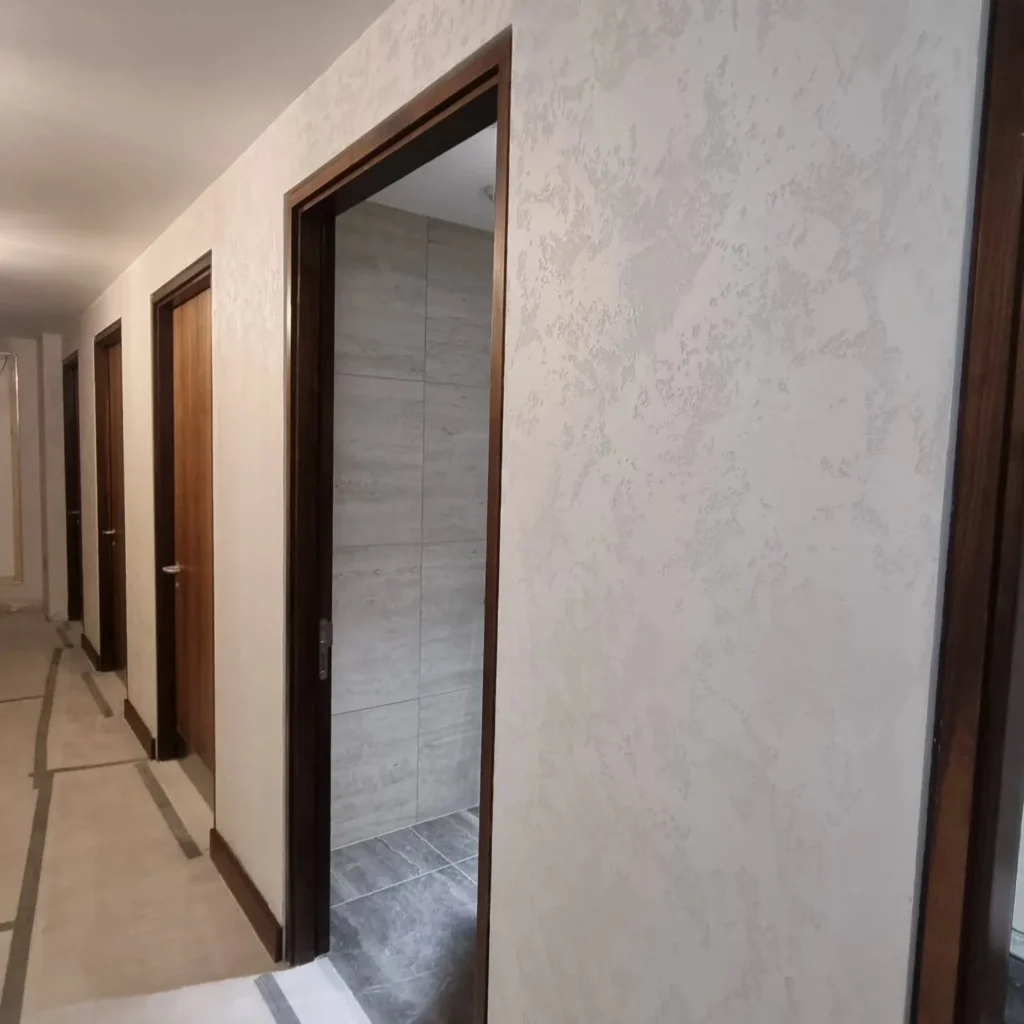
Colour, and why the sample panel matters
Colour sits in the material rather than on it, which is a real advantage on a hallway wall. It also means colour behaves differently from a paint chart. Lime lightens as it cures, so a wet panel is always darker than the finished wall. Deep saturated colours are harder to keep even across a large surface, and very dark tones show a hand mark that a mid-tone hides. We tell you if the colour you have picked will be difficult on that particular wall rather than find out halfway through.
Read more +
So every job starts with a physical panel in your colour, in your room, in your light. A screenshot of somebody else's wall in Milan tells you nothing about how the same pigment reads in a north-facing Dublin sitting room in February.

We apply Marmorino across Ireland
Bellart Decor applies Marmorino, Travertino and polished marble across Ireland from Kilcullen, Co. Kildare, most weeks in Kildare, Dublin, Cork and Galway. 20+ years of decorative finishes, and the same craftsman on your wall from the first day to handover.
We also work in Carlow, Cavan, Clare, Donegal, Kerry, Kilkenny, Laois, Leitrim, Longford, Louth, Mayo, Meath, Monaghan, Offaly, Roscommon, Sligo, Tipperary, Waterford, Westmeath, Wexford and Wicklow, scheduled in blocks so a burnished wall is finished in one continuous run.
5-7 working days on most projects, whatever the size of the room. 2 or 3 year warranty.
Tell us the room and the colour you are thinking of and we will make up a Marmorino panel you can stand in front of. Quotes follow a look at the wall, not a phone call.
What does Marmorino cost?
Marmorino sits at the lower end of the three Venetian plaster finishes because it takes fewer layers: the material cost barely differs, the hours do. The price follows the area, the flatness of the wall and whether it is a ceiling or a whole room. We price after we have seen the wall, with any preparation as a separate line. For the full breakdown, and what a cheap quote leaves out, see our Venetian plaster cost page.
Venetian plaster cost →How we apply Marmorino
The full sequence is on Venetian plaster. Three things are specific to this finish.
Marmorino is tolerant, not magic. A 5 mm dip stays a 5 mm dip, so we fill, level and prime first. Over tiles, the joints are filled and a bonding primer goes on so grout lines do not read through.
A base coat evens out the suction of the wall, then the finish goes on in thin coats, each one thinner than the last. The number of coats depends on the wall and the look you choose, and it is set at the sample stage.
The plaster is pressed with a steel trowel once it is set enough to take pressure, but before it is too dry. Bathrooms and kitchens then get a protective wax. Most walls can be touched within a few days of finishing.
Caring for a Marmorino wall
Once it is finished, a Marmorino wall needs very little. This is what day-to-day care, small repairs and upkeep look like over the years.
A soft dry cloth for dust and a barely damp cloth for marks. Avoid vinegar, lemon, bleach and abrasive pads, because acid dulls lime plaster.
A scuff from a chair or a bag usually wipes off with a damp cloth. The colour runs all the way through, so there is no paint layer to wear away.
A deeper knock is filled, re-trowelled and burnished locally. On a matte finish the repair blends in, which is why Marmorino suits hallways and stairs.
Waxed walls in bathrooms and kitchens benefit from a fresh coat every few years. It refreshes the depth of the colour and takes around half a day.
Marmorino questions
?
What is Marmorino plaster made of?
Slaked lime, marble or stone dust, and pigment. No acrylic, no resin. The lime binds the dust and then cures into calcium carbonate, the same mineral as limestone, which is why it hardens with age.
?
Is Marmorino the same as Venetian plaster?
It is one finish within the Venetian plaster family, not a different product. All Marmorino is Venetian plaster; not all Venetian plaster is Marmorino.
?
How thick is Marmorino?
A millimetre or two across two or three thin coats. It is a finish, not a levelling coat. It will not straighten a wavy wall, and any dip left in the preparation will still be there at the end.
?
Can Marmorino be used on a ceiling?
Yes, and it is the finish we recommend up there over the polished ones, because a matte ceiling does not reflect light fittings back at the room. It takes longer overhead than the same area on a wall, which shows in the quote.
?
Does Marmorino work in a north-facing room?
Yes, and better than the gloss finishes. A polish needs light to reflect; Marmorino gets its depth from the layers. In a north-facing room we steer you towards a colour with some warmth in it, because cool greys go flat in that light.
?
Can Marmorino be repaired if it gets damaged?
Yes, better than any other finish in the family. A damaged area is filled, re-trowelled and re-burnished, and on a matte or satin Marmorino a skilled patch blends in.
?
Is Marmorino more expensive than painting a wall?
Yes, several times over on day one. It can work out better value over many years if you stay, because there is no repaint cycle. Whether that maths works for you depends on how long you are staying.
?
Is Marmorino a paint?
No. It is a lime plaster, not a paint film: the colour sits in the material and the surface is burnished, not rolled on.
?
Can Marmorino be used in a bathroom?
On walls and ceilings outside the direct spray of the shower, yes, waxed for water resistance. Steam is fine; standing water is not. Inside a shower enclosure we use microcement over tanking instead.
?
Is Marmorino better than microcement?
They do different jobs. Marmorino is a lime finish for walls and ceilings, soft and burnished, with depth. Microcement is a cement-based coating that also goes on floors, worktops and wet rooms. For a whole room, a hallway or a chimney breast in a low-sheen stone look, Marmorino. For a surface that gets wet or walked on, microcement.
?
How much does Marmorino cost?
It sits at the lower end of the three Venetian plaster finishes because it takes fewer layers. We quote after seeing the wall, with preparation as a separate line. See our Venetian plaster cost page.
Other plaster finishes and rooms
Sample panel
See the finish on your own wall before you commit
Tell us the room and the look you are after. You get a sample panel in your colour and an itemised quote.