Venetian plaster · hand-applied
Venetian Plaster Walls and Ceilings in Ireland
Bellart Decor does Venetian plastering on walls and ceilings across Ireland, from our base in Kilcullen, Co. Kildare: feature walls, halls, stairwells, landings, snugs, and the and ceilings. It is 1-2 mm of lime and marble dust, burnished by hand, so skirtings, sockets and architraves all stay where they are. It is also thin enough to hide nothing, which is why half this page is about preparation. Kildare, Dublin, Cork and Galway most weeks.
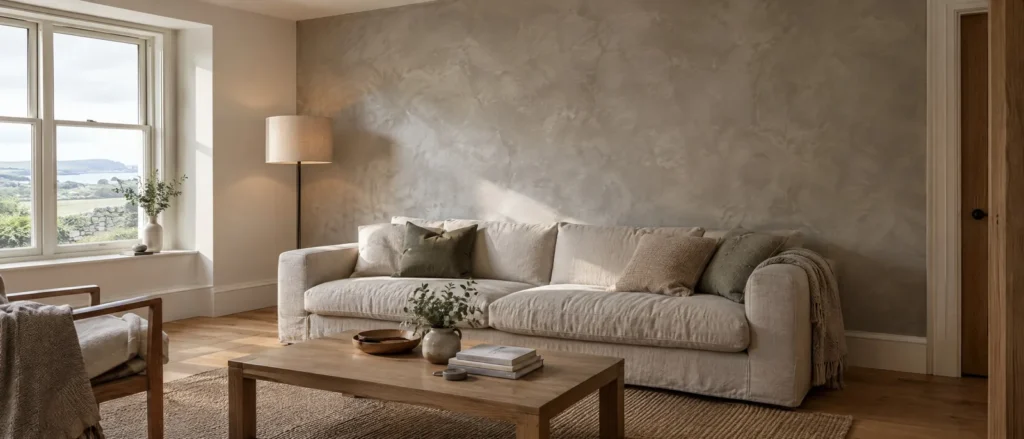
Rooms or feature walls
Over plaster or board
Joint-free ceilings
Which wall to pick for a Venetian plaster feature wall
The wall matters as much as the finish. Three things make a good one:
A burnished surface works by reflecting light at different angles across its own movement. A wall lit from the side, with a window on the adjacent wall or a lamp close to it, shows all of that. Lit flat from in front, it shows almost none, and you have paid for depth you cannot see.
Behind a sofa, facing the door, the chimney breast, the end of a landing.
The strength of the material is that it is continuous. A wall broken up by two doors, a radiator and a boxed pipe gives you four small patches and a lot of edges.
The wall a dog lives against, or a child's bedroom at knee height. It is hard-wearing, but a deep gouge is a repair, and a repair has to be feathered out by someone who knows the finish.
Venetian plaster feature walls: living room, bedroom, hall and TV wall
A feature wall earns its place when it is the one surface the eye goes to. In a living room that is usually the wall behind the sofa or the chimney breast; in a bedroom, the wall behind the bed; in a hall, the wall you face as you come in; and for a TV wall, the one with the screen and shelving, where a low-sheen Marmorino keeps the TV from reflecting in it. Plaster is continuous, so a feature wall reads as one slab with no joints, and it holds up better than wallpaper or panels. We install feature walls across Ireland, most weeks in Dublin, Kildare, Cork and Galway.

Venetian plaster for hallways and stairwells
The best-value work we do, because a hall is mostly wall.
Venetian plaster ceilings
Ceilings are the hardest surface in this trade, because you cannot judge the finish overhead. You are under it at an acute angle with the trowel above your shoulder, so the coats go on thinner and there are more of them.
The ceiling is genuinely part of what you see as you move through.
Small, low enough to read as a surface, lit by lamps rather than downlights.
Practical as much as looks: steam condenses on ceilings and lime copes better than emulsion. → Venetian plaster bathrooms
Each panel can be worked as its own piece.
Where we are cautious: a large flat ceiling with downlights or a rooflight, which is the raking light problem.
Venetian plaster ceilings and raking light: why it shows everything
Raking light travels almost parallel to a surface rather than hitting it face on: a downlight 300 mm from a ceiling, a rooflight, low winter sun. It turns a 0.5 mm undulation into a visible shadow, and it shows up a poor plasterer, a poor skim underneath and every place a trowel stopped and started. People notice bad plastering in extensions because rooflights rake the ceiling.
If there is a row of downlights close to a ceiling we say so, and sometimes the right advice is to move them first.
Travertino absorbs the shadow play because the surface is meant to be uneven. Polished marble under a rooflight is a test almost nothing passes. → Travertino
At 1-2 mm, plaster hides nothing.
Flat frontal photographs tell you nothing. Ask for a wall shot along its length with the light grazing it. That is the shot we send.
What the wall underneath has to be
Joints taped and filled properly, or they show as straight lines through the finish within a year. Screw heads set below the surface, boards fixed tight to the studs, and a primer for a thirsty surface.
Cracks cut out and made good rather than filled and hoped over. Blown areas off. Old gloss or built-up emulsion abraded and primed. If there has been a leak, we find out whether it has stopped.
Fine if they are sound, well fixed and nowhere hollow. We tap every tile, degrease the surface, prime it and level the grout lines, so the grid does not read through the finish.
A levelling render goes on first. At 1-2 mm, plaster is not a levelling product: it follows the wall underneath, so any unevenness in the blocks or brick would show through the finish.
Lime will not trap water, but it shows where it is: a damp patch reads as a shadow behind a burnished wall. A moisture problem gets solved first, or we do not take the job.
How many coats of Venetian plaster, and how thick
Marmorino takes two or three thin coats, Travertino a couple more with the texture worked into the last, and polished plaster several more, each burnished before the next. Total thickness is 1-2 mm either way.
Lime hardens by taking up carbon dioxide and keeps getting harder for weeks after it looks finished. Worth knowing before you hang pictures on it.
What a Venetian plaster quote includes
Eight things on every walls and ceilings quote, itemised, so you can see what a cheaper one leaves out.
Moving downlights, re-skimming a wall that needs a plasterer, or fixing damp. Where those are needed we say so at survey stage and either price them separately or tell you who to get in first.
What the wall is, how the light falls on it, whether anything is moving, whether there is moisture behind it.
Taping and filling board joints, treating screw heads, cutting out cracks, taking off blown areas, abrading old gloss, levelling grout lines, rendering blockwork where it needs it.
Plasterboard drinks; plaster that dries too fast cannot be burnished.
With a physical sample in the real colour and finish, left in your room.
Several thin coats over the primer, each allowed to take up, the final passes burnished.
Skirtings, architraves, sockets, floors and stairs covered; the site left clean at the end of each day.
Chosen per wall rather than applied by default.
Cleaning, what to keep off it, 2-3 years depending on the project.
Caring for a Venetian plaster wall
A dry microfibre cloth or a soft brush is most of the maintenance. Marks come off with a damp cloth and warm water.
Bleach, abrasives and anything acidic. Lime plaster is calcium carbonate and acid dissolves it.
Hall and living room walls do not need re-waxing the way a bathroom does, but a busy hallway can have the wax refreshed if it starts to look tired. A chair leg through it can be repaired and feathered out far enough that the eye cannot find the join.
Ready to plan your walls and ceilings?
Send us a few photos of the room and we will come back with a sample panel in your colour and a clear, itemised quote.
Recent Venetian plaster walls and ceilings
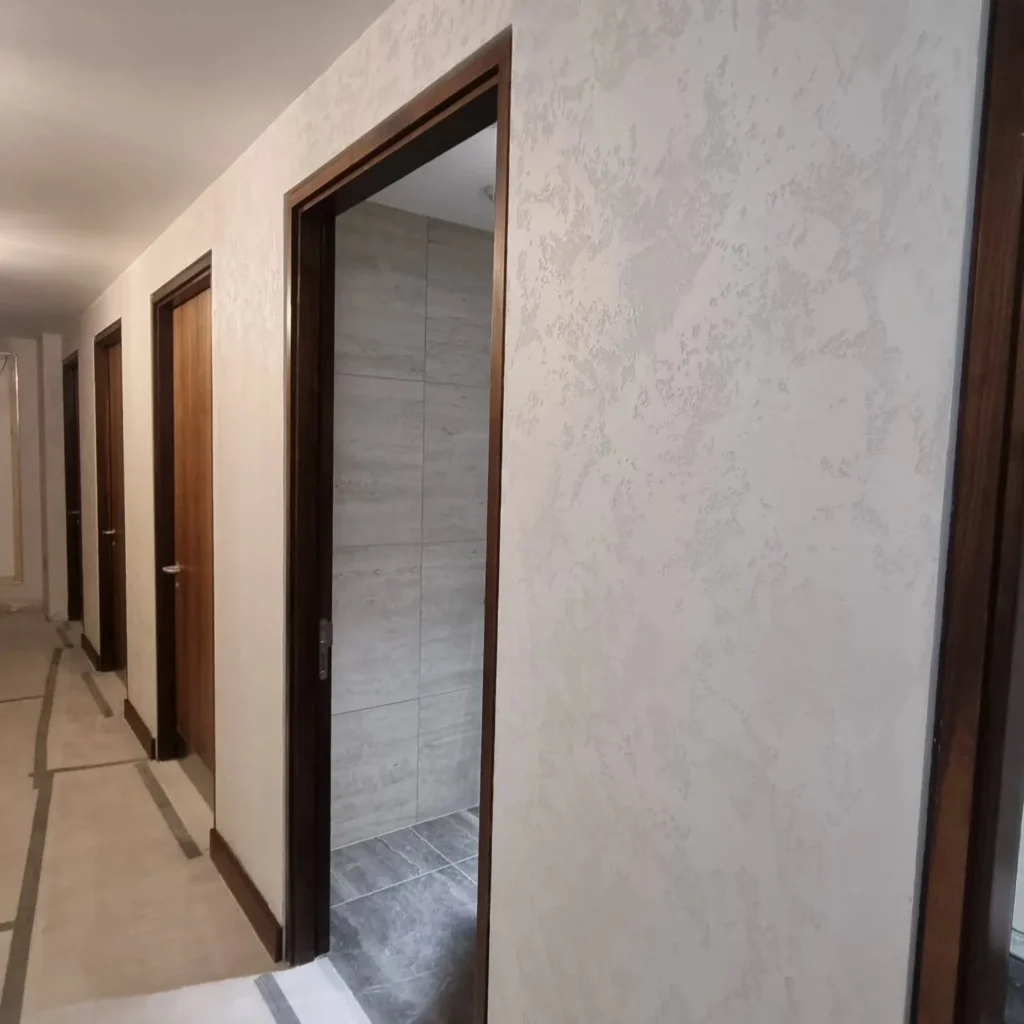
Hallway wall in Venetian plaster
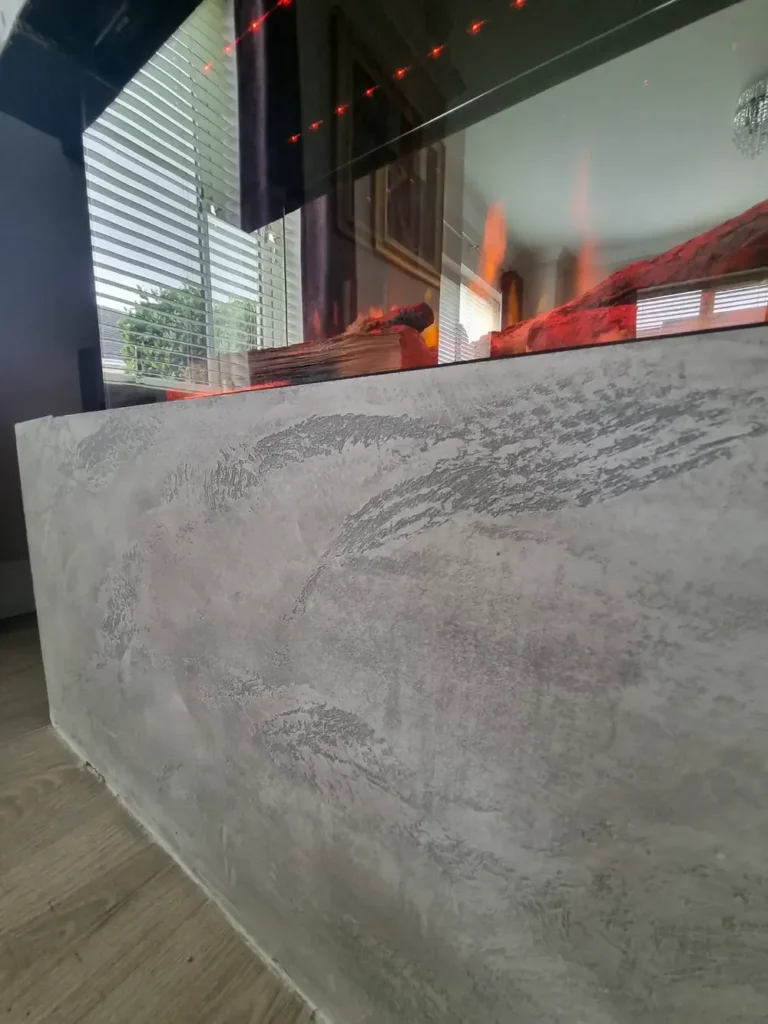
Plaster wrapped round a fireplace base

Chimney breast in textured grey plaster
What decides the price of Venetian plaster walls and ceilings?
The finish you choose (Marmorino, Travertino or polished marble), the area, the height and the condition of the wall or ceiling. Ceilings cost more than walls because they are slower to apply and need more preparation. We price after we have seen the room, with any substrate work, such as board joints or a skim coat, as a separate line. For finish-by-finish pricing, see our Venetian plaster cost page.
Venetian plaster cost →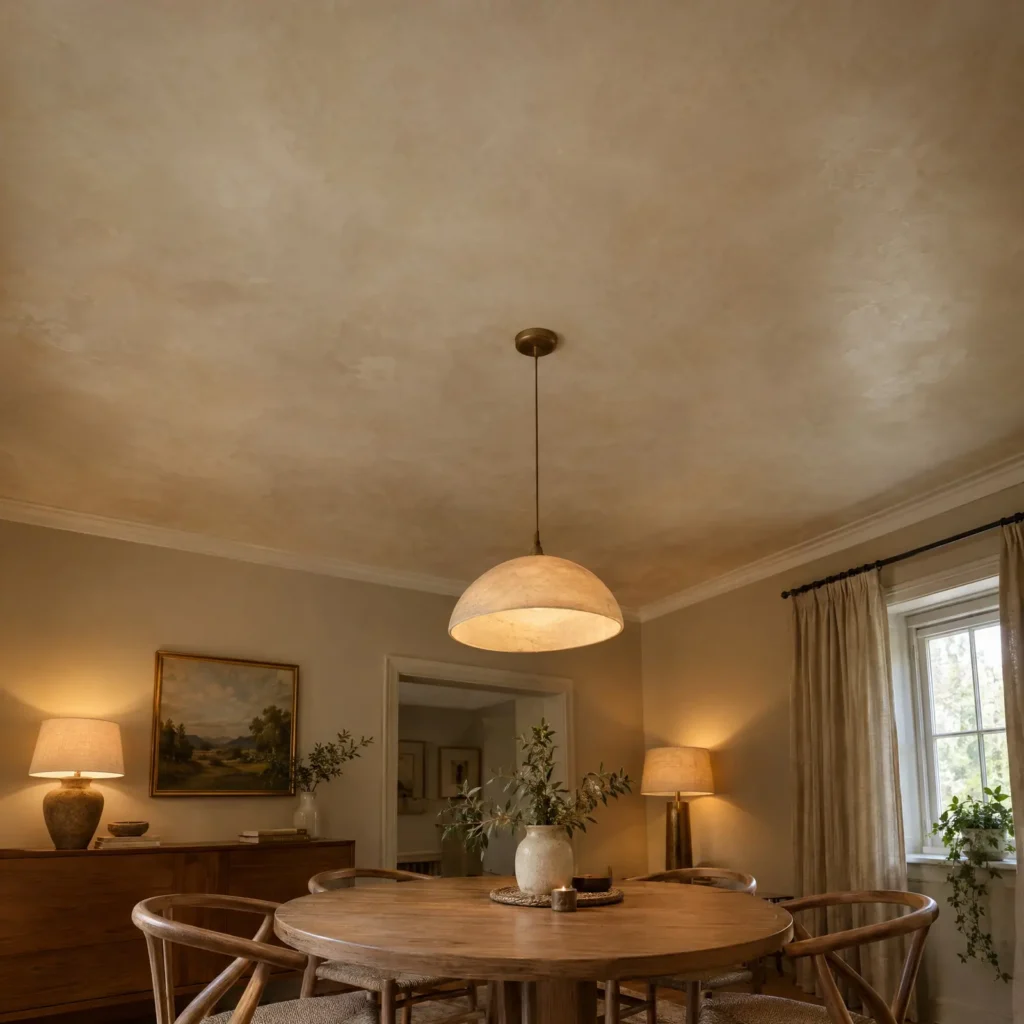
Venetian plaster walls and ceilings across Ireland
We work nationwide from Kilcullen, Co. Kildare. Kildare, Dublin, Cork and Galway most weeks. Counties further out are scheduled in blocks.
We also work in Carlow, Cavan, Clare, Donegal, Kerry, Kilkenny, Laois, Leitrim, Longford, Louth, Mayo, Meath, Monaghan, Offaly, Roscommon, Sligo, Tipperary, Waterford, Westmeath, Wexford and Wicklow, scheduled in blocks.
Venetian plaster walls and ceilings questions
?
Can you put Venetian plaster on a ceiling?
Yes, and it is the hardest surface in a house to do well, because you cannot judge the finish overhead. It suits halls, landings, snugs, bathroom and panelled ceilings.
?
Does Venetian plaster work on plasterboard?
Yes, on properly finished plasterboard: joints taped and filled, screw heads treated, boards fixed tight, and a thirsty-surface primer. That board work is part of our job.
?
Can Venetian plaster be painted over?
Yes, technically, and it is not reversible: you cannot get the burnish back without re-plastering. Live with a sample for a few days first.
?
Does Venetian plaster crack on walls?
It can, for the reason any rigid finish cracks: something underneath moved. A springy board, an untaped joint, a crack filled rather than cut out. We will not plaster a wall we think will move.
?
How long does Venetian plaster last on a wall?
Decades indoors, if the substrate was right. It hardens over time rather than degrading like a film, so it does not peel. The wax on a busy wall wears and can be refreshed.
?
How much does it cost to Venetian plaster a wall or ceiling?
It depends on the finish, the area and the state of what is underneath. Ceilings cost more than walls because they are slower to apply and need more preparation. We quote after seeing the room, with substrate work as a separate line. See our Venetian plaster cost page.
?
Which wall should I choose as a feature wall?
The one with side light from a window or a lamp, that you look at rather than walk past, and that is one plane from corner to corner: behind a sofa, behind a bed, a chimney breast or the wall you face coming in. Avoid walls broken up by doors and radiators.
?
Is Venetian plaster better than wallpaper or panels for a feature wall?
For a seamless, lasting result, yes: no joints, no seams to lift, and the finish hardens rather than peels. Wallpaper and panels are quicker and cheaper on day one and easier to change later.
Other plaster finishes and rooms
Sample panel
See the finish on your own wall before you commit
Tell us the room and the look you are after. You get a sample panel in your colour and an itemised quote.