
What our clients say
“I can't recommend Haris enough. He's very skilled, respectful and trustful. He was always on time and worked weekends to finish a project which was delayed by another contractor. I am delighted with the microcement in my bathroom. I will choose Haris again.”
“I couldn't recommend Harris more highly. Such a lovely person, extremely knowledgeable, particular and punctual. Came onto a job that was left in a mess by …”
“We had the pleasure of working with Haris on a microcement project, and we couldn't be happier with the results. His passion for his craft is evident in every …”
Commercial microcement sectors we work in

Hotels
Corridors, lobbies, bedroom floors, en suites and public bathrooms, done floor by floor so the hotel keeps trading.

Restaurants and bars
The hardest working floors we do: constant footfall, nightly mopping, spilled everything, and a service area wet for six hours a night.

Offices
Receptions, breakout spaces, feature walls and washrooms, in an occupied building with other tenants, a service lift and rules about noise and hours.

Retail and showrooms
A floor and walls that hold the eye on the product, and a surface that survives a refit every few years.
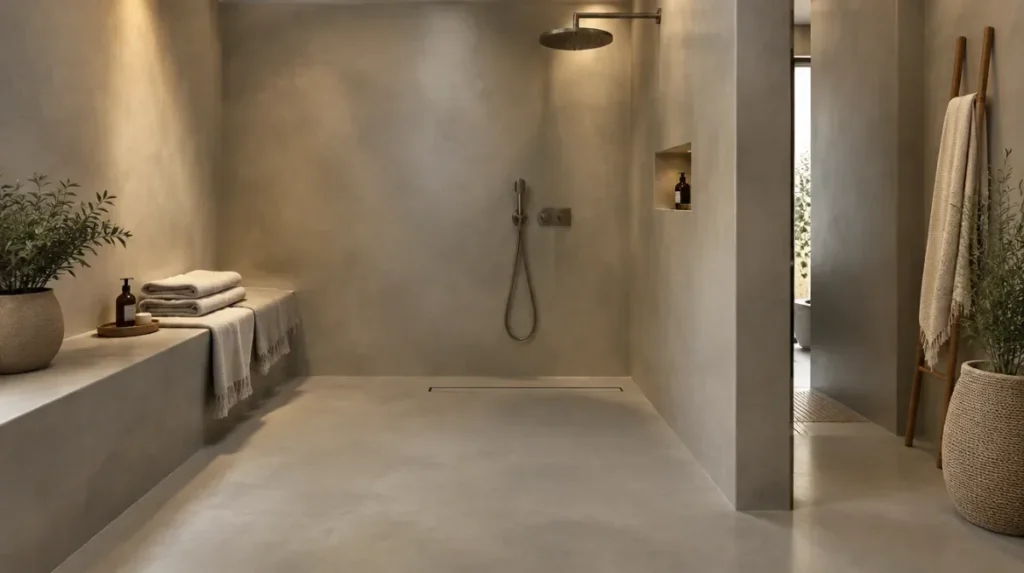
Spas and wellness
Wet rooms, treatment rooms, pool surrounds and changing areas, everything tanked before a single layer goes on.
What is included in a commercial quote
From the drawings, itemised by zone.
Substrate type, moisture testing rather than assumption, movement joints, point loading, the zones and how each is used.
Written down, not one build-up applied everywhere.
Grinding, levelling, crack and joint treatment, priming, and tanking in wet areas before any finish goes on.
In the specified colour and finish, for sign-off before we start.
Nights, weekends, phased zones, or sequenced into a wider fit-out.
Slip resistance specified per zone rather than for the whole job.
Marked on the drawing before we start.
Cleaning and maintenance guidance for the operations team, and 2-3 years depending on project type.
Commercial microcement price and programme
Quoted from drawings rather than from a rate, because the substrate, the zoning, the out-of-hours working and the system choice move the figure far more than the square metres do. There is no per-m² price here for that reason. You get a specification per zone, a programme duration and an itemised quote.
What the floor underneath decides in a commercial project
Choosing a system is not a matter of upgrading. It follows from the substrate and the use.
Power-floated concrete, screed, existing tiles or timber. Each has a different preparation route, and timber in a commercial setting needs particular care because it moves.
On a ground floor with no membrane, or a slab that is not fully dry, moisture will push a coating off from underneath. It gets tested, not assumed.
A commercial slab has them for a reason and they do not disappear because there is a coating on top. Ignoring one is the most common way a commercial microcement floor cracks.
Shelving legs, a bar counter, a till plinth, a pallet truck. Wheels and steel feet are harder on a floor than people are.
Read more +
We do not claim microcement never cracks. It cracks when what is under it moves, when joints are ignored or when moisture is trapped. We tell you where the risk is before you sign, and if a substrate cannot be made right we turn the work down.
Which Lunik system, and the build-up
Everything comes out of one range, with primers and sealers made to work with it, so a specification is one build-up per zone rather than assembled from whatever is in stock.
Read more +
System
Suits
OnePox
Heavy traffic and demanding conditions.
OneRock
Lighter use, four grain sizes from smooth to rustic.
Terrazzone
Seamless terrazzo without slabs, joints or weight, over the same substrates as the rest of the range. Worth knowing about for commercial interiors in particular.
OOXID
Metallic feature surfaces in steel, bronze or brass.
The sealer is chosen for the wear rather than the look. Technical data → More on Products

Specification support for architects and designers
We would rather be involved before the drawings are issued. Bellart Decor is the official and exclusive distributor of the Lunik system for Ireland and Northern Ireland; Lunik is the manufacturer, in Spain. That matters on a specification for three reasons.
You specify against Lunik's technical data rather than a reseller's summary of it.
It comes through us, not through a merchant.
If something goes back to the manufacturer mid-job, it comes back to the company doing the work. Enquiries reaching Lunik in Spain for a project in Ireland or Northern Ireland are referred to us.
Read more +
What we provide: specification per zone, the manufacturer's data sheets, sample panels in the specified colour, substrate and moisture requirements written into the preliminaries, joint detailing, and a programme duration.
We will also say when a detail will not work: a coating asked to bridge a movement joint, a timber substrate with no allowance for deflection, a slab with no damp-proof membrane. Better raised at design stage than carried out.
Recent commercial projects
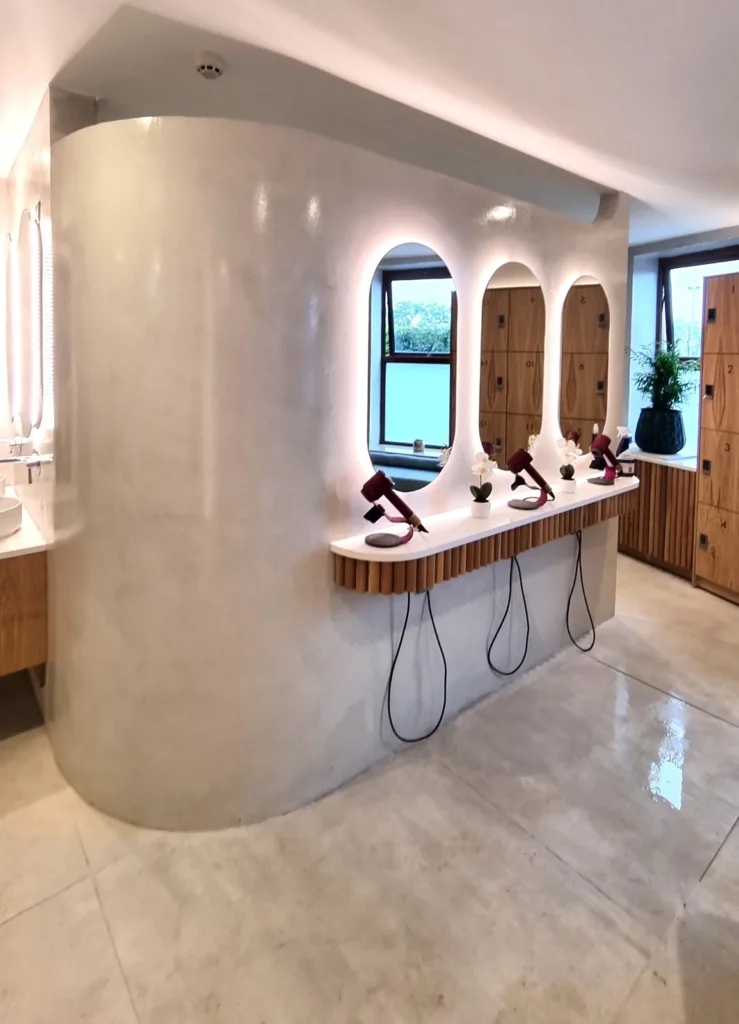 Spa washroom: curved microcement wall
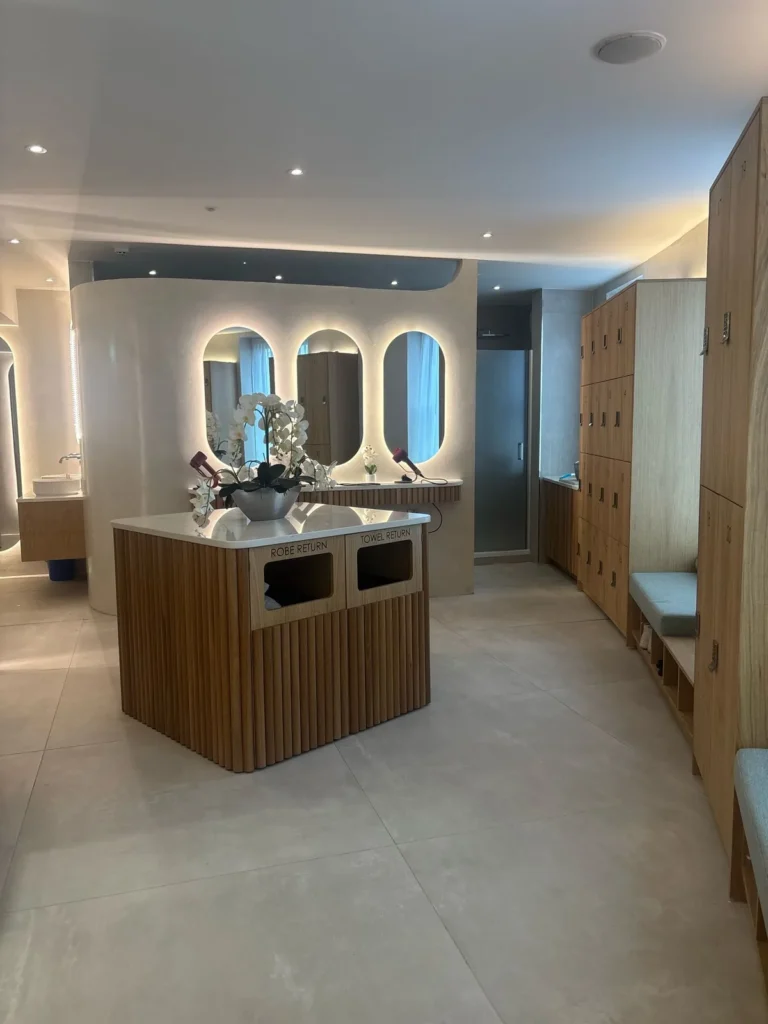 Spa changing area: microcement floor
 Reception desk finished in microcement
Send us the drawings
Floor plans, and elevations where walls are involved. A PDF is fine.
With a note on what each zone is used for.
When the space is available, whether it can close, and the programme date.
A slip resistance requirement, the existing floor build-up, moisture test results, the rest of the fit-out programme.
FAQ
Commercial questions
How long am I closed?
Most projects take 5-7 working days, whatever the size, because preparation and curing set the pace rather than floor area.
Out of hours and overnight: where the space cannot close. Bars and restaurants between service and opening, retail overnight.
Phased by zone: half a corridor, one floor of an office, one section of a showroom. There are no joints in microcement, so a work-in junction has to be planned where it will not be seen, and we mark those on the drawing before starting.
Inside a wider fit-out: we would rather be sequenced properly than squeezed in. Our work follows first fix and wants the building watertight, the heating stable and other trades off the floor.
Curing does not negotiate. We can work at three in the morning, but a floor that needs a set number of hours before it takes weight needs them. Anyone promising a floor open the same evening is using a different material.
Will it survive the traffic?
On the right system, yes. The substrate and the use decide which one, not the budget, which is why the specification comes after we have seen the space.
OnePox: the part of the Lunik system built for heavy traffic and demanding conditions, usually with a different sealer specification over it.
OneRock: the everyday-surfaces part. The same hotel lobby done in OneRock would be the wrong call.
Is it safe underfoot when it is wet?
A floor sealed to a high gloss is slippier when wet, so we do not use a gloss sealer on a commercial floor that gets wet.
Where that applies: bar service areas, entrance lobbies in Irish weather, spa and pool surrounds, staff corridors behind a kitchen.
What goes in instead: a textured finish, a slip-resistant sealer, or both, specified per zone rather than for the whole job. An entrance mat well and the meeting room upstairs do not need the same floor.
If your specification carries a slip resistance figure, send it with the drawings. We will not sign up to a rating we cannot evidence.
When can we walk on it?
Light traffic in clean footwear after 48 hours. The sealer takes 5 days to reach full resistance to stains and water, so the floor stays dry for the first 5-7 days, depending on temperature and airflow. Curing cannot be shortened.
The install sits inside the usual 5-7 working days; curing runs on its own clock underneath it.
Who fixes it if something goes wrong?
We do, and there is one company to call.
No argument about whose fault it is: the specification, the material and the labour all come from us, so there is no dispute between a supplier and an applicator.
Repairs are skilled work: a patch that has not been feathered out properly will always be visible, so it does not go to a maintenance contractor.
Zone by zone: localised damage can be made good in one zone while the rest of the space stays open, and the sealer can be refreshed area by area.
Is microcement suitable for a commercial kitchen?
Sometimes, and it needs a proper look first: hot fat, heavy point loads, aggressive chemicals, steam cleaning and hygiene rules all at once.
Do you provide specifications for architects?
Yes: specification per zone, data sheets, substrate and moisture requirements, joint detailing, sample panels and a programme duration. → More on Architects designers
How much does commercial microcement cost?
Quoted from drawings, not from a rate, because substrate, zoning, out-of-hours working and system choice move it more than the metres do. A typical commercial quote is itemised by zone: preparation, the system and sealer for each zone, any out-of-hours working and the programme. Send us the drawings and the areas by zone and we return a specification, a programme duration and an itemised price. → Microcement cost
Start your project
Ready to talk about your room?
Tell us what you have and what you want it to look like. You get a sample in your colour and an itemised quote, with no obligation.