Microcement Bathrooms in Ireland
Walls, floor and shower in one seamless surface, laid over your existing tiles. Every wet zone is tanked first, and there is no grout line anywhere.
5.0 ★★★★★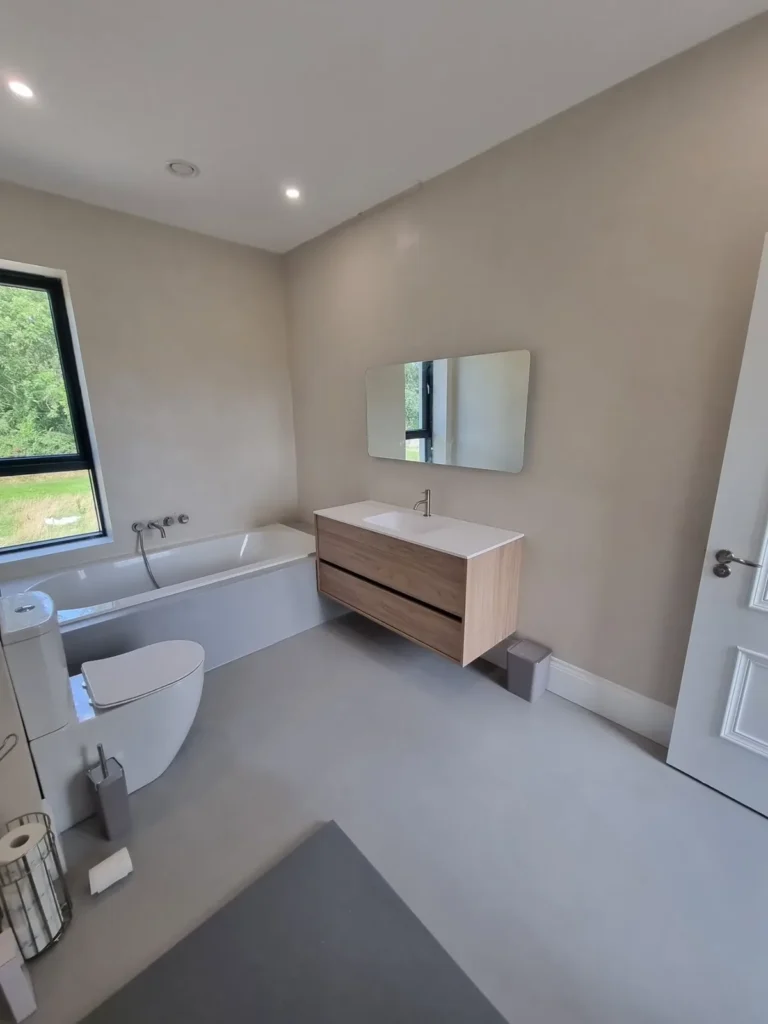
No grout lines to clean
Goes over existing tiles
Every wet zone tanked first
Why choose us for your bathroom
A bathroom is only as good as the preparation under the finish. We check every wall and the floor before we quote, and the same team carries the job from the first visit to handover.
Sound tiles stay where they are and become the base, so there is usually no strip-out, no skip and far less dust.
A liquid membrane and reinforcing tape go in behind every shower and bath before any microcement. The finish is never the only thing keeping water out.
Walls, floor and shower in one surface, so there is nothing to go grey and nothing to re-grout.
What our clients say
“I can't recommend Haris enough. He's very skilled, respectful and trustful. He was always on time and worked weekends to finish a project which was delayed by another contractor. I am delighted with the microcement in my bathroom. I will choose Haris again.”
“I couldn't recommend Harris more highly. Such a lovely person, extremely knowledgeable, particular and punctual. Came onto a job that was left in a mess by …”
“We had the pleasure of working with Haris on a microcement project, and we couldn't be happier with the results. His passion for his craft is evident in every …”
Recent microcement bathrooms
We install microcement bathrooms across Ireland, most weeks in Kildare, Dublin, Cork and Galway. Further out, jobs are scheduled in blocks, so the start date depends on what else is running in that county.
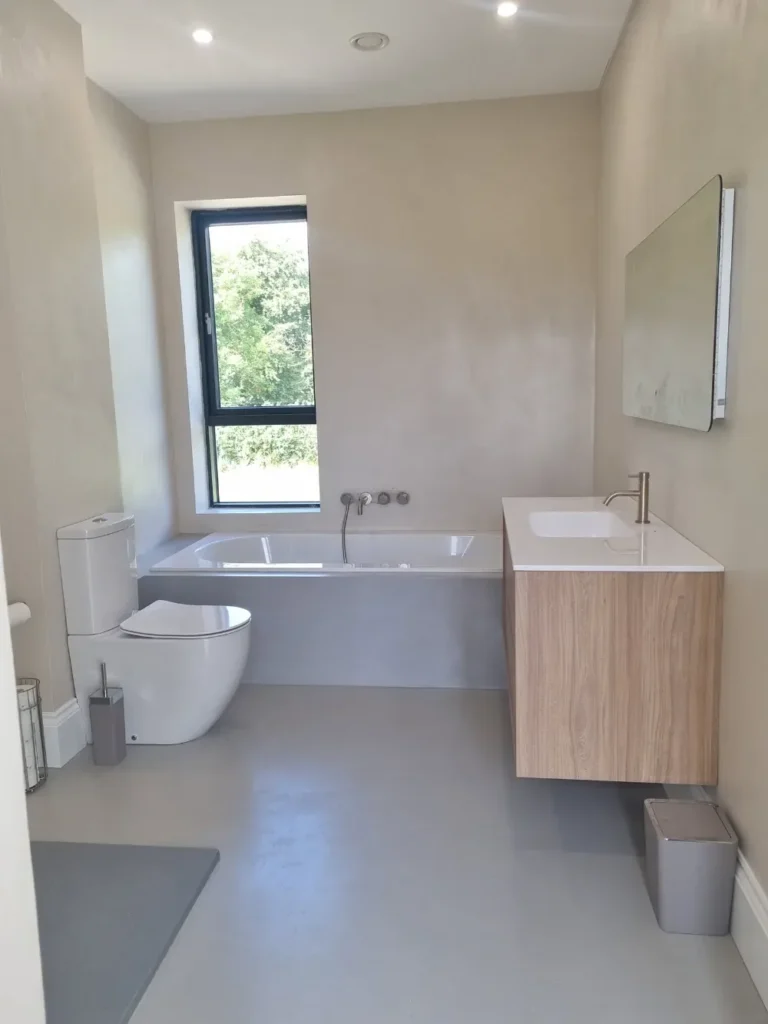
Family bathroom

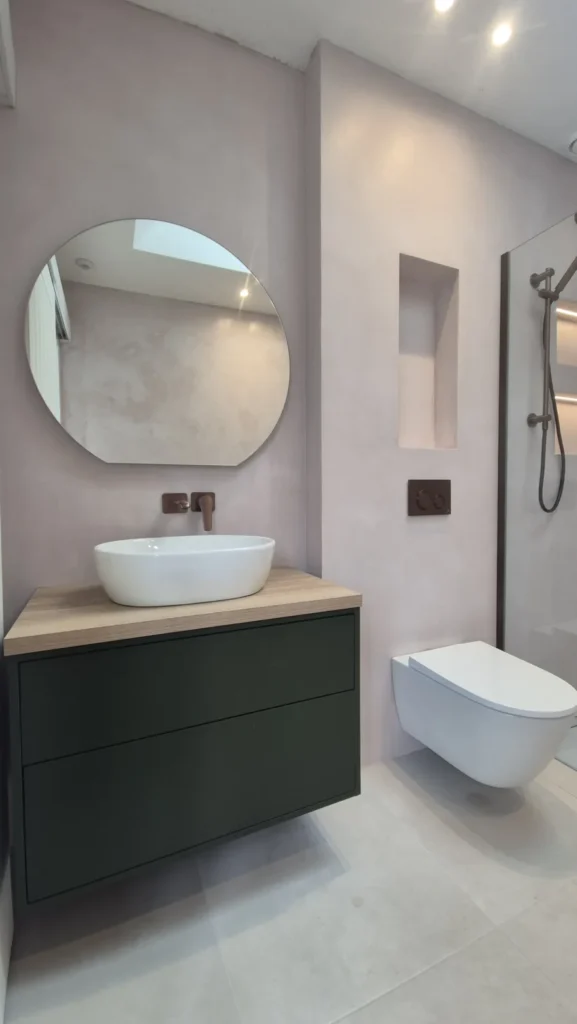
Formed microcement shower tray and recessed niche

The same room before and after
Ready to start your bathroom?
Tell us about your space and send a few photos. We will arrange a visit, look at what is there now and come back with a clear, itemised quote.
Microcement over existing tiles: how we prepare the surface
Sound tiles are a good substrate: flat, rigid, already bonded. What is underneath decides whether the bathroom still looks right in five years, so we tap every wall and the floor before we quote.
Degrease, abrade, fill the grout lines level, prime. The best substrate in the room.
Ideal. Joints taped, then primed.
Paint keyed or removed, joints taped and reinforced, then primed.
Moisture tested, levelled where needed, primed for an absorbent substrate.
Off before we start. It appears as a line on the quote rather than a surprise on day two.
Rebuilt in cement board first. Not optional.
Stiffened first, or we turn the job down.
What decides the price of a microcement bathroom?
The price follows the total surface, walls and floor together, and the work underneath it: how many wet zones need tanking, whether the shower tray is formed in situ, and the condition of the tiles or walls that are there now. We price after we have seen the substrate, with preparation, tanking and sealing as separate lines, so the quote can be compared like for like. Most bathrooms take 5-7 working days, whatever their size, because curing between coats sets the pace rather than the square metres.
Read our guide: microcement cost in Ireland →The shower tray, the niche and the bath
A tray formed in situ, tanked and fallen to the drain, with no lip to clean around. Or your sound existing tray stays and the walls meet it with a silicone joint: cheaper, less good-looking.
One piece with the wall. No cut tile, no mitred edge, no grout in the corners. Corners radiused slightly, because a sharp internal angle in a 2 mm coating is a stress point.
Boxing finished in microcement with a silicone bead at the rim. A thin panel that gives when pressed is rebuilt in cement board first.
Tanking, the layer you never see
Every wet area is tanked before a single layer of microcement goes on: a liquid membrane over the prepared substrate, with reinforcing tape into every internal corner, around the tray and around each pipe penetration. A sealed microcement surface is waterproof, but the waterproofing of a bathroom should never depend on the finish coat alone. Tanking means that if the sealer is ever worn, water still has nowhere to go. It is the least visible part of the job and the part we will not leave out.

Does microcement crack in a bathroom? What goes wrong and how we prevent it
Yes, it can, and nearly all of it is preventable before anything is opened. We do not claim microcement never cracks. We know why it cracks:
A flexing floor or a hollow tile bed cracks a 2 mm coating. Prevented by tapping everything and stiffening floors first.
Microcement over a damp substrate, or sealed before it has cured, lifts and blooms. It is the most common reason we push a start date back.
Where two materials meet, the joint is carried through the coating. Covering one over is how a straight-line crack appears six months later.
Prevented by radiusing corners and reinforcing at tray upstands and thresholds.
Preparation is most of the labour on a bathroom, so a quote that does not mention it is not a like-for-like quote.
The Lunik system in your bathroom
We choose the Lunik system and grain for each part of the room: a finer finish on the walls for an easy wipe-down, and a harder-wearing build where feet and water land. Because we import the material and apply it ourselves, the specification, the workmanship and the 2-3 year warranty come from one company.

Microcement bathroom questions
Can microcement go on a shower tray?
Yes. We form a tray in situ, tanked, fallen to the drain and finished in the wall colour, with no lip and no seal line. Or the walls finish down to your existing tray with a silicone joint.
Does a microcement bathroom need tanking?
Yes, in every wet zone, before any microcement goes on. The membrane and its corner tapes make the room waterproof underneath the finish rather than because of it.
Is microcement waterproof in a shower?
Yes, once it is tanked and sealed. The membrane stops water reaching the wall behind, and the sealer keeps soap and daily splashes off the surface.
Is a microcement shower floor slippery?
It does not have to be. Grip comes from the grain and the sealer: shower trays and wet-room floors get a coarser grain and a slip-resistant sealer where feet land, and we do not put a smooth gloss finish on a wet floor. The sample lets you feel the surface before you commit.
How long does a microcement bathroom take?
Five to seven working days from prep to handover, en suite or family bathroom, because curing between coats sets the timing rather than the size of the room.
Does microcement go mouldy in a bathroom?
Far less than tiles. Mould in a tiled bathroom grows in the grout, which is porous. A sealed microcement surface has no grout and no open joints for it to take hold in. It can still appear on silicone joints or where ventilation is poor, so those are wiped down like any other bathroom surface.
Can you microcement just the bathroom walls and keep the bath and floor?
Yes, and we are asked for it often. It is a smaller job and a smaller bill. The finish stops at the bath rim with a silicone bead, and the wall-to-floor line gets a clean termination rather than running over an old tile edge.
Is microcement good for a small en suite?
Yes. Taking out the grid of grout lines removes the visual break-up that makes a small room feel smaller. Our minimum is 20 m² of surface, counted across walls and floor together, and an en suite with the walls finished usually comes to more than that. Send us the dimensions and we will confirm.
What are microcement bathroom walls like to live with?
Slightly textured depending on the grain, and wipeable in one pass. Warm water, a pH-neutral cleaner and a cloth does the room. Keep bleach, cream cleaners and abrasive pads off it, because they attack the sealer.
How much does a microcement bathroom cost?
It depends on the total surface, how many wet zones need tanking, whether the shower tray is formed in situ and the condition of what is there now. We quote after seeing the substrate, with preparation, tanking and sealing as separate lines, so it can be compared like for like. Our microcement cost guide explains what sits behind a quote.
Is microcement better than tiles in a bathroom?
Neither is right for every room. Microcement removes the grout lines that go grey, goes over sound tiles without demolition and takes 5-7 working days. Tiles are harder against heavy impact, and a damaged tile is replaced one at a time. If you want a seamless, easy-wipe room without a strip-out, microcement is the stronger choice.
More microcement
Get a sample in your colour, and a quote on your room
Tell us the room, roughly how many square metres, and what is on the walls and floor now.