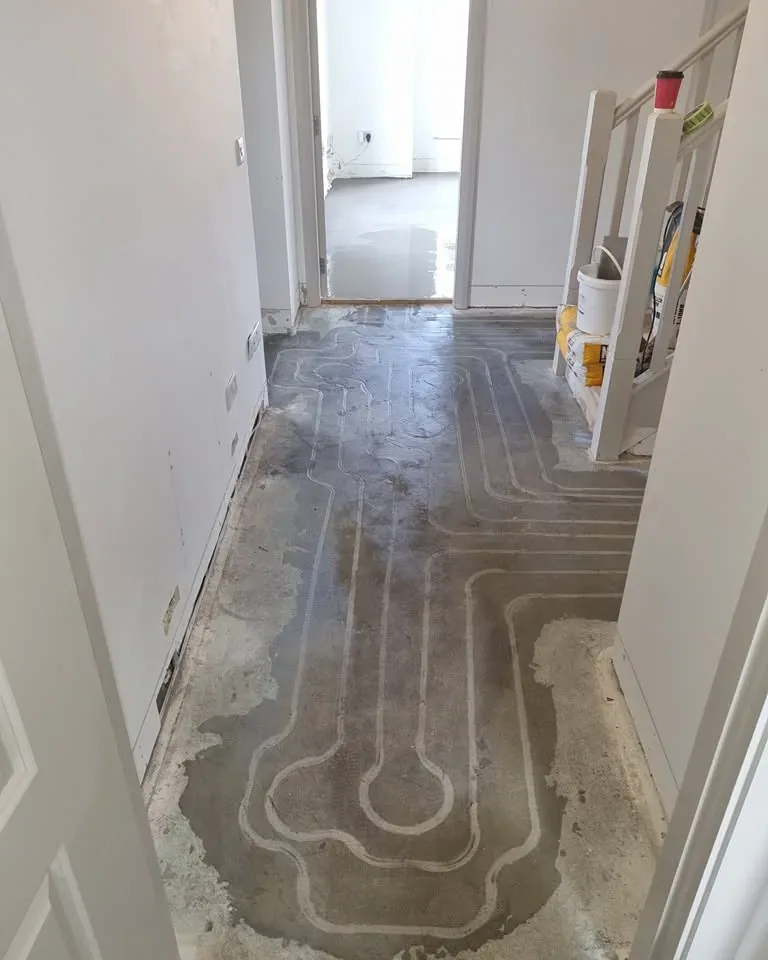
The range moves with the substrate, not the square metres. A sound dry concrete floor and a cracked bathroom floor with a damp patch are the same area and nowhere near the same job. Every quote follows a look at what is underneath. If you are new to the material, start with what microcement is.
Microcement prices in Ireland at a glance
Where it usually sits in the €120–€250 per m² range
Notes
Bathroom or en suite
Upper end
Highest per m², smallest total. Tanking and detail work
Wet room or shower
Upper end
Tanked and detailed before any microcement goes on
Floor
Middle, lower on large areas
Best value per m², and the rate drops as the area grows
Walls and ceilings
Lower end
Lowest per m²: no tanking, no slip spec, less sealer
Kitchen worktop or splashback
Quoted as a job
Priced as a job, not by the metre. Spec carries the cost
Timeline: most projects take 5-7 working days, whatever the size of the room, because drying time between layers sets the pace rather than the area.
Warranty: 2 or 3 years depending on the project. Which term applies to your job is written on the quote before you accept it.
These are general figures for Ireland, not our price list. Most microcement jobs here come in between €120 and €250 per m², towards the top with heavy preparation, wet-area tanking or a lot of detail in a small space. For an exact price for your space, contact us for an itemised quote.
Why a microcement bathroom costs more per m²
Bathrooms sit at the higher end per square metre and they are the most common project we do. The reason is detail, not area: walls, floor, tray, niche, reveals and drain all have to meet, and the wet zone is tanked first. A small en suite can cost more per m² than a large living-room floor and still be a smaller bill.
How much does a microcement floor cost in Ireland
Floors are the best value per square metre: the area works in your favour and there is less edge detail per metre. Going over existing tiles or a sound screed removes the biggest cost in a floor replacement, which is taking the old one out.
Walls, worktops and small areas
Walls and ceilings are usually the least expensive per square metre: no tanking, no slip considerations, less wear, less sealer. Worktops are the opposite. Small area, constant use, heat and acid, so the specification carries the cost rather than the size.
 Before
 After
The same bathroom before and after. Floor, bath panel and walls all meet, which is why bathrooms sit at the upper end per m².
What decides microcement cost per m²
Six things, roughly in order of how much they move the number.
#
Factor
What it does to the price
1
The substrate, and what it needs first
The biggest single variable, and the one nobody can price over the phone. Cracks get cut out and repaired, not covered. Hollow tiles come off. Uneven floors get levelled, because 3 mm of microcement copies a floor rather than correcting it. Moisture has to be tested. On one bathroom that is half a day; on another it is three days and a levelling compound.
2
Which system the room needs
A hall floor, a wet-room tray and a bar floor take different systems from the Lunik range and different sealers. The harder systems cost more in material and in labour, and putting a domestic system into a commercial floor to save money is how you pay twice.
3
How many surfaces meet
Price per m² is a blunt instrument in a small room. A 4 m² bathroom where floor, walls, tray, niche and window reveal all have to meet cleanly carries far more detail work per m² than a 40 m² open-plan floor. Small rooms cost more per m², not less.
4
Wet areas
A shower or wet room is tanked before a single layer goes on: membrane, corner tapes, the drain detail, the falls. That is a separate trade operation inside the same job.
5
Access and the state of the site
Third floor with no lift, a lived-in house with one bathroom, a kitchen that has to stay usable, parking, protecting adjoining finishes. None of it is exciting and all of it is time.
6
The finish you choose
Grain and sealer sheen change the labour more than the material. A near-smooth finish takes more passes and more sanding than a coarse one. See microcement colours and finishes.
What our microcement price includes
One quote, itemised, covering:
A look at the room and the substrate before any number is given: moisture, cracks, movement joints, existing finishes, how you use the space.
All preparation: removing what has to come off, crack repair, levelling, grinding, priming.
Tanking and waterproof detailing in showers and wet rooms.
The Lunik system chosen for that room, supplied by us. We are the official and exclusive distributor of the Lunik system for Ireland and Northern Ireland, so material and workmanship come from the same place.
Base and finish layers applied and sanded by hand, and the sealer coats.
Protection of the rest of the house while we work, and a clean site at the end.
Care instructions at handover, and a warranty of 2 or 3 years depending on the project.
Most projects finished in 5-7 working days, whatever the size of the room.
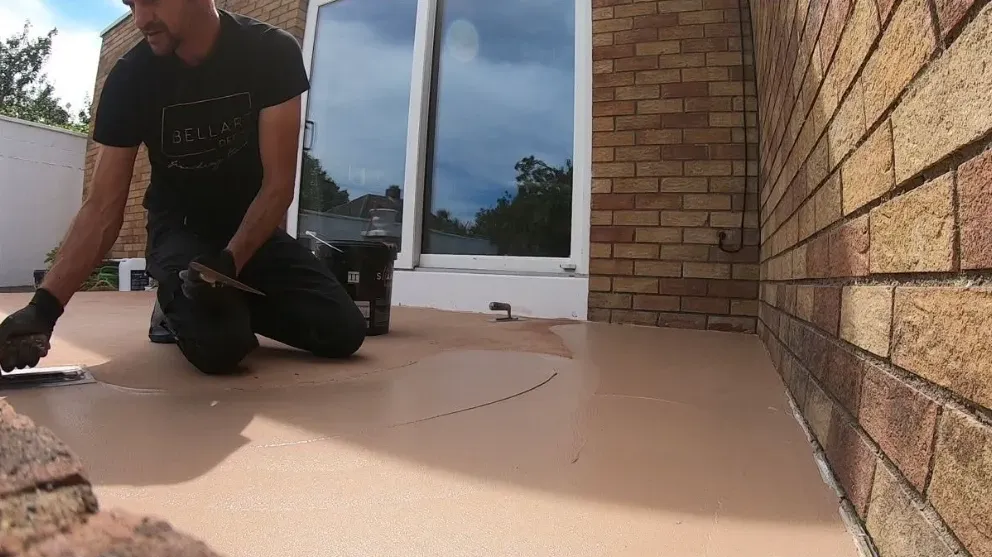
Base and finish layers are applied and sanded by hand, then sealed.
What a €50-60 per m² quote usually is
You will see figures at that level in Ireland. They are almost always one of three things.
What it is
What that means
Supply only
Material in a bucket, no labour. Supply-only kits are sold at a fraction of an installed price. That is an honest number for what it is, and it is not a finished floor. If nobody is quoting for the application, the application is not in the price.
Application with no substrate work
The coating goes straight onto whatever is there. No moisture test, no crack repair, no levelling, no tanking. This is the one that looks fine on handover day and is where most of the horror stories come from. The failure shows up in the first heating season.
A price for a surface, not a system
Microcement is a primer, base layers, finish layers and a sealer, and there is more than one of each. A cheap quote usually means the cheapest combination, chosen on price rather than on what the room needs.
None of this makes low quotes dishonest. It makes them different products. Comparing two microcement prices comes down to one question: which one includes the preparation?
Why we do not publish a full price table
You will find Irish microcement pages with a complete table: so much per m² for bathrooms, so much for floors, so much for walls. It reads well, and it is the first thing we get asked for.
We do not publish one, for a reason we are happy to put in writing. Every number in a table like that assumes a substrate nobody has looked at. Quote a bathroom at a table rate and one of two things happens: either the preparation gets priced properly later and the customer feels the number moved, or the preparation gets left out to protect the rate. We have seen the second often enough to be blunt about it.
That is why the range at the top of this page is a general figure, not a quote. We give you the range up front, tell you what moves it, look at the room, and hand you an itemised quote that does not change.
Microcement against retiling
Most people reading this are not choosing between two microcement firms. They are choosing between microcement and ripping the old surface out. Compare totals, not rates.
What you pay for
Retiling a bathroom
Tile removal and making good · skip hire · repairing or replacing the substrate · backer board or a new screed where needed · tanking · the tiles · adhesive and grout · a tiler's labour · silicone and trims · roughly two weeks with the room out of use, longer if the substrate turns out worse than expected.
Microcement over the same bathroom
One quote, 5-7 working days, no demolition, no skip, no tiles to choose and no grout to re-do in three years.
Two things follow. The microcement figure covers trades that are separate line items in a tiling job, which is why comparing €/m² against a tile price per box tells you nothing. And at 2-3 mm the floor level barely changes, so doors, thresholds and skirtings usually stay, which is real money that never appears on a tiling quote until the job has started.
Where retiling wins: when the substrate has to come out anyway. Rising damp, a failed membrane, a floor that moves, tiles laid over a problem. We will tell you if that is your situation.

Microcement goes over the existing surface, so there is no tile removal or skip.
Microcement pricing across Ireland
We quote across Ireland, most weeks in Kildare, Dublin, Cork and Galway. Our rates are the same in every county; distance affects scheduling, not the price.
How to get an accurate number
An accurate microcement price for your room takes four steps.
Tell us the room and roughly the size, and what is on the floor and walls now: tiles, screed, plasterboard, vinyl, painted plaster.
Send a few photos, including a close one of any cracks and the corners of the shower.
You get a physical sample in the colour and grain you are considering, and an itemised quote.
Ready for a number for your room?
Send the room, rough size and a few photos. We reply with an itemised quote.
Microcement price questions
Is micro cement expensive?
More expensive per square metre than paint or vinyl, and broadly comparable with a good tiling job once you count removal, skip, substrate work, tiles, adhesive, grout and labour. What makes it look expensive on paper is that a microcement quote is one line covering several trades.
How much does a microcement bathroom cost?
Bathrooms sit at the upper end of the range per m² and are quoted as a room, not a rate, because a small en suite has more detail work per m² than any other space: walls, floor, tray, niche and drain all have to meet, and the wet zone is tanked first. The total is usually smaller than a floor.
How much does microcement flooring cost?
Floors are the best value per m²: there is less edge detail per metre and the rate drops as the area grows. Going over sound tiles or screed removes the biggest cost in a floor replacement, which is taking the old one out.
Is microcement cheaper than tiles?
Not on material, yes on the total in most refurbishments. Tiling adds removal, a skip, substrate repair, adhesive, grout, trims and about two weeks with the room unusable. Microcement goes over the existing surface in 5-7 working days. Compare the finished job, not the rate.
Why do microcement quotes in Ireland vary so much?
Because they are not quoting the same thing. Ask any quote three questions: is the material included, is substrate preparation included, and is the wet area tanked before the microcement goes on.
Is there a minimum size for a microcement job?
Yes, 20 m². Every project gets the same assessment, preparation, waiting between coats and sealing regime whether it covers 6 m² or 60, and below 20 m² that cannot be done to the standard the warranty rests on. If you think you are close, measure the walls as well as the floor.
Can I do the preparation myself to bring the cost down?
No, and this is the one place we will not compromise. Preparation is what the warranty rests on: if we did not test the moisture, cut out the cracks and prime it ourselves, we cannot stand over what happens on top. Cost comes down in other ways: a coarser grain, a matte sealer, a whole floor at once.
How much does a microcement worktop cost?
Worktops are priced as a job, not by the metre: a small area with heavy daily use, heat and acid, so the specification and sealer carry the cost rather than the size. The state of the board underneath, the sink and the splashback all count. We quote after seeing the kitchen.
Is microcement worth the money?
For most refurbishments, yes, because it removes the demolition, skip and retiling that a tile job adds, and it is done in 5-7 working days. It is the wrong choice where the substrate has to come out anyway, or where you may move on soon, since it is not designed to be removed.