Venetian plaster · hand-applied
Venetian Plaster Bathrooms Ireland
Bellart Decor installs Venetian plaster bathrooms across Ireland, from our base in Kilcullen, Co. Kildare. Vanity walls, the wall behind a freestanding bath, en suites, cloakrooms and ceilings, in lime and marble dust burnished by hand at 1-2 mm over sound tiles or a made-good skim. Inside the shower we use microcement over tanking instead, fitted by the same crew on the same visit. Kildare, Dublin, Cork and Galway most weeks.
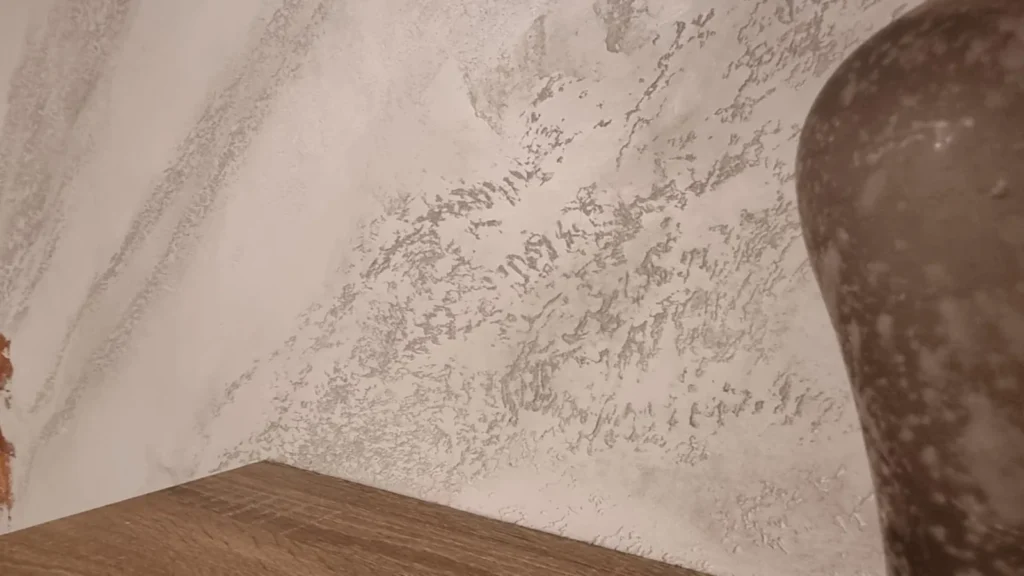
Waxed to handle steam
Seamless vanity walls
Pairs with microcement
Where Venetian plaster goes in a bathroom
It is a wall finish, not a waterproofing system. Where the wall gets wet air it lasts. Where it gets wet water it is the wrong material.
Splashes get wiped rather than soaked in. Glass or stone at the tap, plaster above it.
Water arrives as steam and the odd splash, not as a jet.
The towel rail wall, and the wall you see when the door opens.
Steam condenses on ceilings and lime copes with that better than emulsion. It is why bathroom ceilings blotch first in most houses.
No shower, no bath, plenty of wall at eye level. The easiest win in the house.
Yes, as long as the shower itself is finished in something else.
Is Venetian plaster waterproof?
No. It is water-resistant, and that difference decides where it goes.
Slaked lime loaded with marble dust lets moisture in and back out. Breathable and waterproof are opposites.
Steam, condensation, and a splash that gets wiped.
Water running down the same square metre twice a day for five years. The sheen flattens, then the lower corner of an enclosure starts to break down.
Standard Venetian plaster and Marmorino are not waterproof, and no wax or sealer makes them so. For a wet area we build the look in microcement over tanking instead.
Where we use microcement instead
Inside the shower, on the bathroom floor, on wet room walls and floors, and around a bath that children use.
Microcement is 2-3 mm of cement-based coating over a tanking system, so the waterproofing sits under the finish instead of being asked of it.
The sealer is chosen for the floor it is going on, not for the look.
Same crew, same week, 2-3 years covering plaster and microcement together.
If you want polished plaster inside the shower, what you actually want is microcement: a similar hand-applied look, built to be wet.
What is included
Eight things on every bathroom quote, itemised, so you can see what a cheaper one leaves out.
What the wall is, moisture readings, cracks, movement, the extraction, and where water lands when the room is in use.
Degreasing, cutting out cracks, taking off loose tile, levelling grout lines, the right primer for that substrate.
The shower and the floor, before anything goes over them.
From what the survey found, not from a menu.
Left in the room, for morning daylight and for the lights at night.
Thin coats, each allowed to take up, the last passes burnished with a steel trowel.
Chosen per wall rather than applied by default.
Cleaning, what to keep off it, 2-3 years depending on the project.
Sealing and waxing
We would always wax a bathroom wall, because the wax is the layer you refresh rather than the plaster you redo.
Soaks in and cuts absorption, so a splash beads for a few seconds and a mark wipes off instead of staining. No film, no waterproofing.
Sits on top, deepens the colour, lifts the sheen, and takes the wear instead of the plaster.
Which finish suits a bathroom
Pale warm whites and greys do the most work in an Irish bathroom: the rooms are small and the daylight is flat for much of the year. A deep colour looks superb on a sunny afternoon and heavy in November.
Slaked lime and marble dust, soft sheen. The most forgiving of the three: low enough sheen that it does not spotlight water marks, and it waxes well. → Marmorino
Textured and stone-like. Texture holds water and dust the way rough stone does, so we keep it away from basins and out of reach of spray. → Travertino
Mirror depth, no forgiveness, every dried drip on show. It goes on the wall you look at, not the wall you use. → Polished marble
Ready to plan your bathroom walls?
Send us a few photos of the room and we will come back with a sample panel in your colour and a clear, itemised quote.
What we check in a bathroom before we quote
Four things, before a price:
Plasterboard, render, old skim or tiles each take a different primer. A hollow tile under a burnished finish telegraphs through within a year.
A north-facing wall with poor extraction is a moisture problem waiting to happen, and lime will show you it is there. Sometimes the right advice is to fix the extraction first.
Hairline cracks in the existing skim come through 1-2 mm of plaster. They get cut out and made good, not covered.
We stand in the room and work out the splash zone before deciding what goes where.
If a room cannot be done properly, we say so and turn the job down.
Venetian plaster bathroom ideas
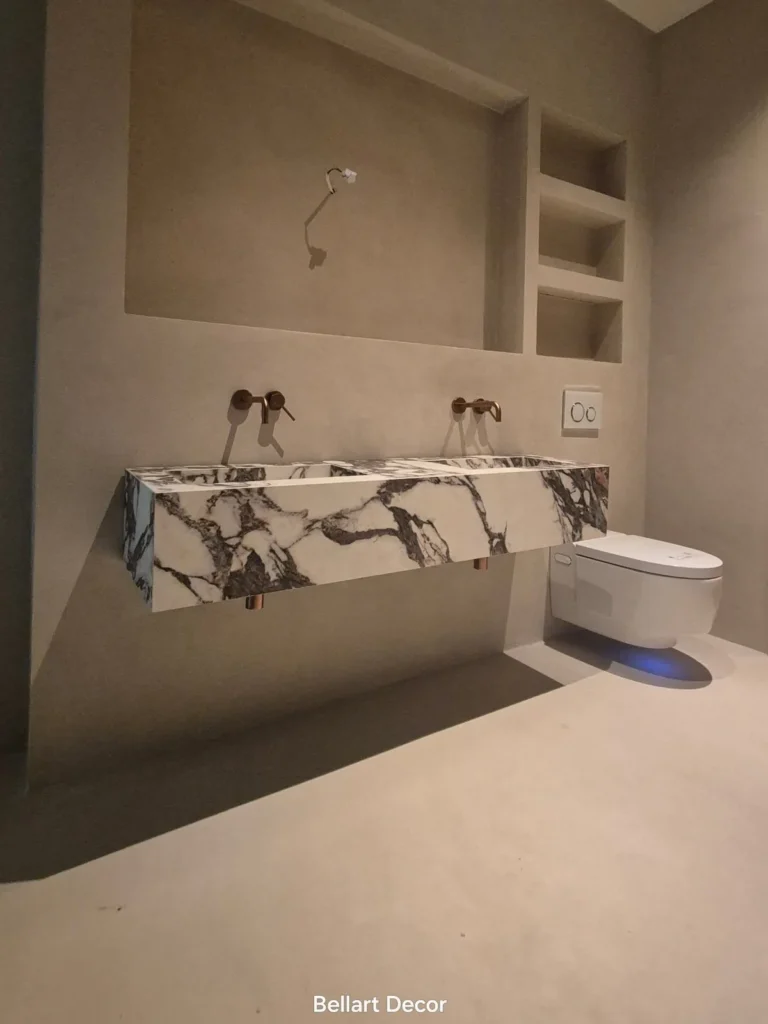
Venetian plaster walls around a floating vanity
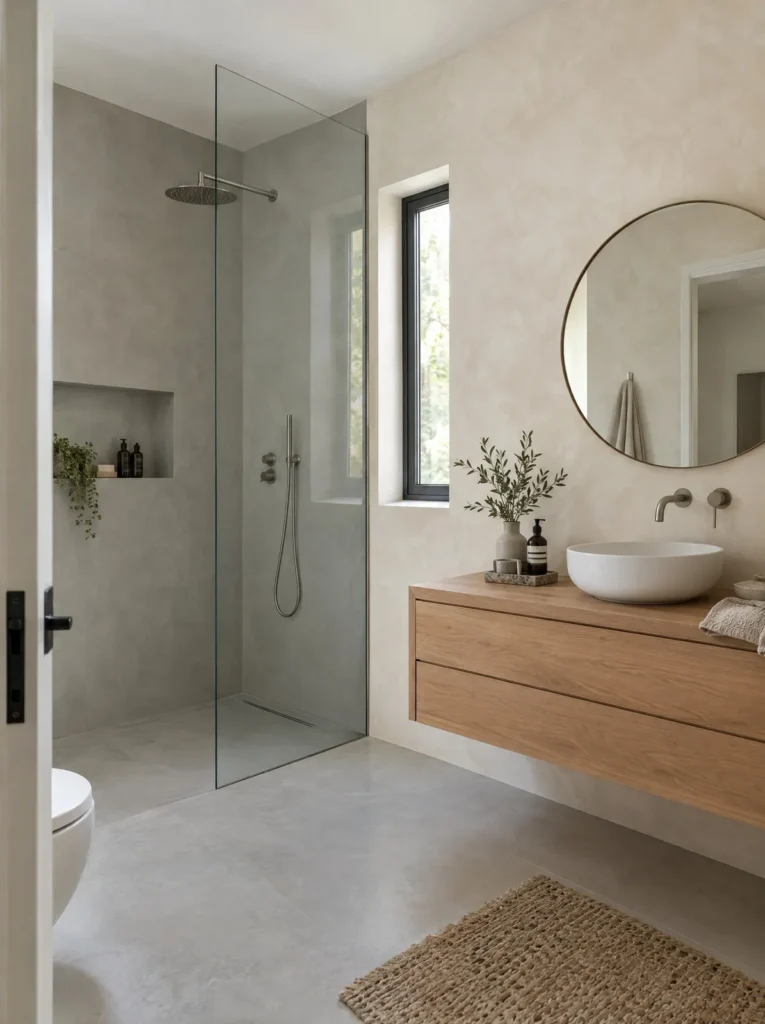
Microcement shower with Marmorino on the remaining walls
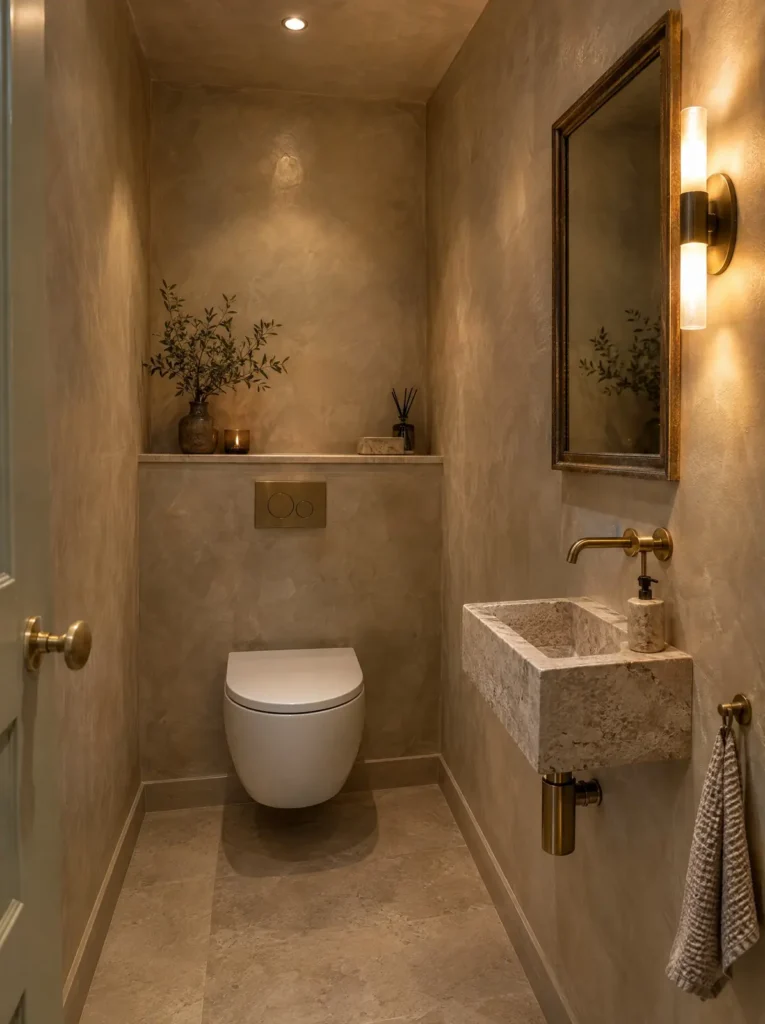
Downstairs cloakroom in Venetian plaster
Venetian plaster bathroom questions
?
Is Venetian plaster waterproof?
No, water-resistant. Lime is breathable, so it handles steam, condensation and splashes that get wiped, but it is not a membrane and should not line a shower.
?
Can you use Venetian plaster in a shower?
No, and we will not quote for it. Daily water dulls the sheen and breaks the surface down. That look is achievable in microcement. → Wet rooms
?
Does Venetian plaster go mouldy in a bathroom?
Far less than grout, because there is no grout to colonise. Mould is usually a ventilation problem, and poor extraction finds somewhere else to grow.
?
Can Venetian plaster go over bathroom tiles?
Yes, if they are sound, well fixed and nowhere hollow. Degreased, primed, grout lines levelled first. That is why there is no skip outside the house.
?
Does Venetian plaster need waxing in a bathroom?
Yes, always. The wax takes the wear instead of the plaster.
?
How long before you can use the bathroom after Venetian plaster?
Lime keeps hardening for weeks, so go easy on the steam at first. We give you the timings for your room in writing at handover.
?
Is Venetian plaster better than bathroom wall panels?
For a seamless, finished-looking room, yes: there are no joints, trims or fixings, and the surface has depth rather than a printed pattern. Panels are quicker to fit and cheaper on day one. Venetian plaster belongs on walls outside the direct spray of the shower; inside it we use microcement.
?
How much does a Venetian plaster bathroom cost?
It depends on the finish, the area and the state of the walls, and it is priced with preparation as a separate line. We quote after seeing the room. See our Venetian plaster cost page.
Other plaster finishes and rooms
Sample panel
See the finish on your own wall before you commit
Tell us the room and the look you are after. You get a sample panel in your colour and an itemised quote.