Venetian plaster · hand-applied
Venetian Polished Plaster Ireland
Bellart Decor installs Venetian polished plaster across Ireland, from our base in Kilcullen, Co. Kildare. Feature walls, powder rooms, reception areas, columns, curves and ceilings, over a wall that is flat or can be brought flat. It is slaked lime and finely ground marble, laid on in several thin layers and burnished until the surface closes and reflects, under 2 mm thick. The same craftsman is on your wall from the first day to handover.
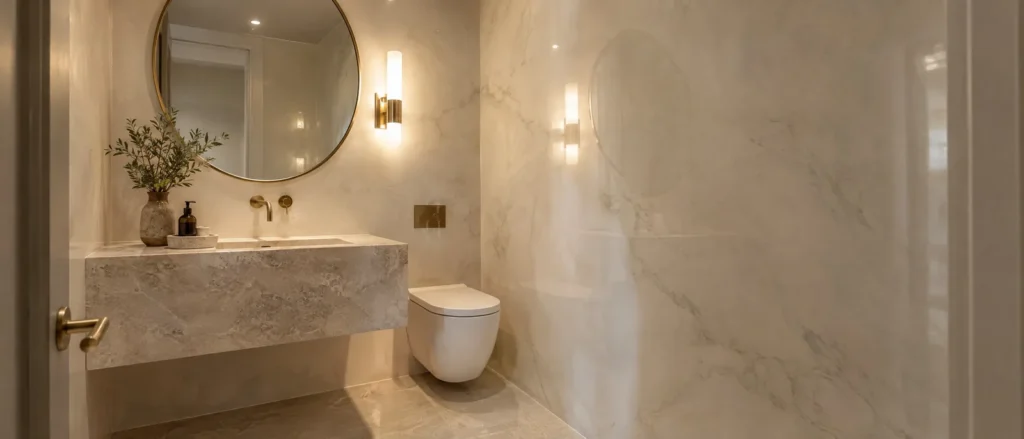
Burnished to high gloss
Deep marble veining
Seamless, no joints
What Venetian polished plaster is
Same family as Marmorino: lime binder, marble dust body, pigment for colour.
Coarse stone dust gives grain, which is what you want in a Marmorino and not here. A fine marble flour can be compressed until there is no visible texture left at all.
A matte finish is two or three coats. A full polish takes several more, each skimmed on in a film you can nearly see through and then worked back.
Looking through those layers. That is why it has a sense of thickness paint never has, despite the whole build being well under 2 mm.
Carbon dioxide from the air turns the lime into calcium carbonate, the same mineral as marble.
A marble-look coating over something else. It is genuinely made of marble, held together by lime.
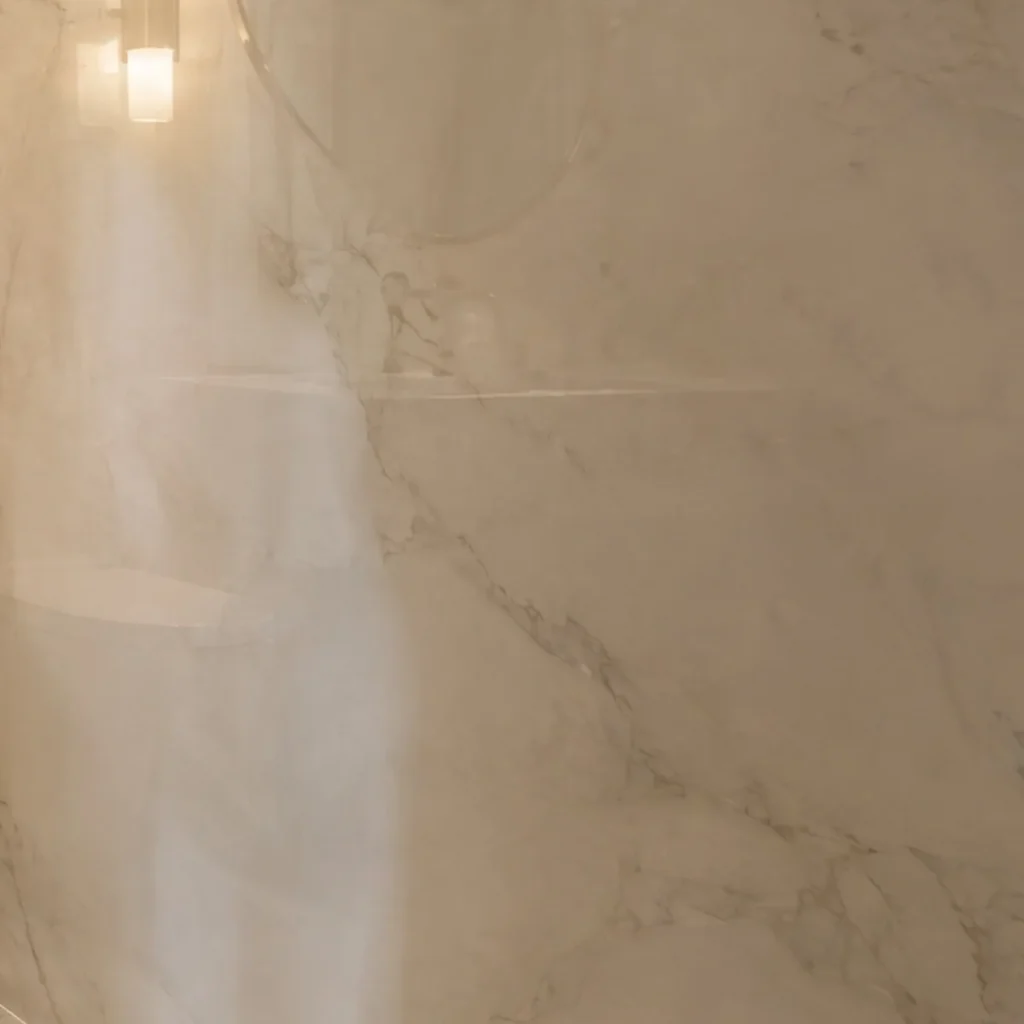
How the shine is made, and why it is not varnish
The sheen is in the plaster, not on it. There is no lacquer and no clear coat.
The trowel is worked over the setting plaster until the surface compacts and the marble particles align, and the wall goes from matte to satin to something close to a mirror. The blade edge does the final work.
Too wet and the trowel drags material off. Too dry and it burns black marks in that have to be cut back out.
Then the wall is protected, usually with a wax, sometimes with a soap treatment on the very highest polish. Wax deepens the colour and slows water and marks getting in. It is not what makes it shiny.
Read more +
Two things follow. The shine can be renewed later by re-waxing and re-burnishing. And there is no film to peel, blister or yellow, because there is no film.
White, grey and the colours that work
We put a true white and an off-white on the same panel, and you will almost always pick the second.
The most requested and the hardest to get right. Lime is naturally off-white, and pushing it to a cold pure white takes pigment that can flatten the depth you paid for. Most of the white walls people admire in photographs are a bone or a soft greige, and they read as white in the room.
Suits this finish, and a mid-grey polish reads like honed marble. Cool greys can go flat in a north-facing room; a grey with some warmth in it holds up better in average Irish light.
Charcoal, deep green, oxblood. The most striking and the least forgiving. A dark high-gloss wall shows fingerprints, and it shows every ripple in the wall behind it, because a dark mirror is a better mirror.
A wet panel is always darker than the finished wall. Judging colour off a fresh trowel is how people end up disappointed.
A scratch shows the same colour rather than white plaster underneath.
Polished plaster or marble-effect panels, tiles and slabs?
If you are pricing marble-effect wall panels or tiles for a feature wall, a bathroom or a hallway, this is how polished plaster compares.
The straight answer: across a whole wall, a stairwell or a curve, polished plaster gives a better result than slabs because there is no grid in it. If you want one dramatic book-matched vein behind a bath, go with the stone. Plaster will not give you that.
Venetian polished plaster
Real marble slab
Joints
None, anywhere. Round corners, into reveals, over a whole wall
Every slab edge shows. Book-matching helps and costs
Weight
A couple of millimetres. No structural question to answer
Heavy. Fixings, substrate and sometimes the wall itself need checking
Room lost
Negligible
20 mm plus adhesive off every wall
Curves
Follows them
Does not
Veining
Subtle, made for the wall. It will not imitate a dramatic Calacatta vein
The real thing, and no plaster matches it
Acid and staining
Marks with acid; wax slows it
Marks with acid. Marble is no better here
Repairs
Re-burnish, or redo the panel to the nearest corner
Replace the slab and hope it matches
Cost driver
Hours
The stone, plus templating, cutting and fixing
The wall behind it has to be right
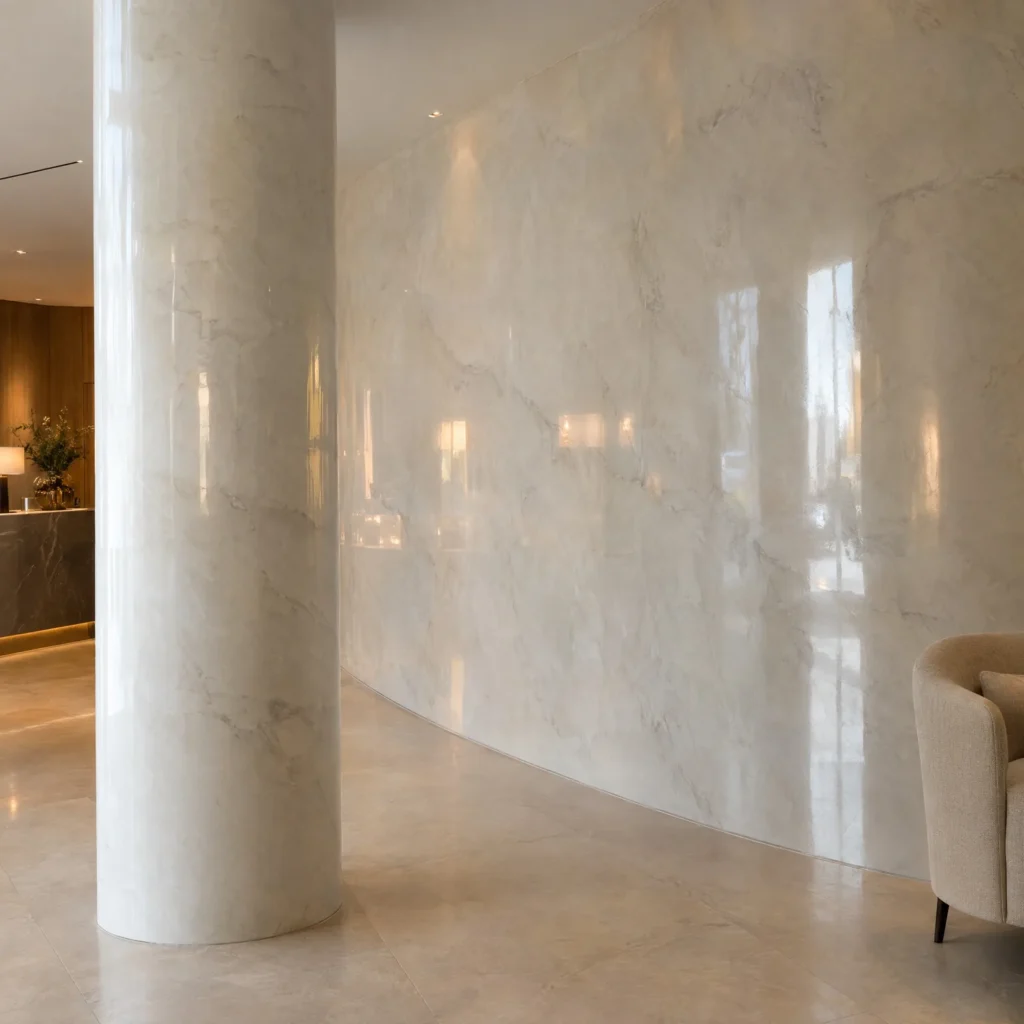
A polished wall is a mirror, and a mirror shows everything: a bulge you would never notice in matte paint, a taped joint that was never properly filled, a screw head, the shadow where an old dado rail came off. That is not a fault in the lime coats. It is the wall underneath, showing through a finish thinner than a coat of paint. Same argument as microcement, that a finish fails from below and not from above, with the standard set higher.
Flatness under a straight edge, before we quote.
Plasterboard joints and screw heads properly filled.
Old paint tested for adhesion, and off where it has gone.
Moisture and movement on solid, external and new-build walls.
Read more +
If the wall needs a skim coat first, we price it. If it cannot carry a polish at all, we say so and put a Marmorino on it instead, which forgives what a polish will not → Marmorino
Light is half the finish
Where the light comes from changes this finish more than the colour does.
The hardest test a polished surface can face: a window at one end of a long hallway, or a downlight tight to the wall washing down it. Every deviation in the substrate turns into a shadow. If that is the wall you want polished, the preparation has to be priced for it, and we say so before we quote rather than after.
From a window on an adjacent wall, or fittings set well out from the surface. This is where the finish looks its best.
Wastes it. In a dark internal room with nothing to reflect, a polish just looks like dark paint.
The suggestion we make most often: keep downlights off the polished wall and light it from across the room. Costs nothing at first fix.
Where polished plaster works, and where it does not
Where polished plaster works:
Feature walls in a living room or bedroom, especially behind a bed or a fireplace → Plaster walls and ceilings
Small, seen, not lived against. One of the places this finish earns its keep in an Irish house.
This finish exists for surfaces that get looked at → Commercial
No grout anywhere is the selling point → Venetian plaster bathrooms
A hall table against a polished wall is fine; a narrow passage with bags going through it is not.
Ceilings, curves, columns and arches, where no stone will do it without joints. → Kitchens and fireplaces
Where it does not work:
Polished plaster or another finish for your wall
The wall is flat or can be brought flat, lit from across the room rather than raked along its face, and looked at rather than leaned on.
The wall is in daily use, the room is dark, or the substrate is sound but not flat. It forgives what a polish will not, and it patches years later without the repair showing.
You want texture, pores and veining, rather than reflection. The better call on a chimney breast.
What you want is one dramatic book-matched vein. Plaster will not give you that.
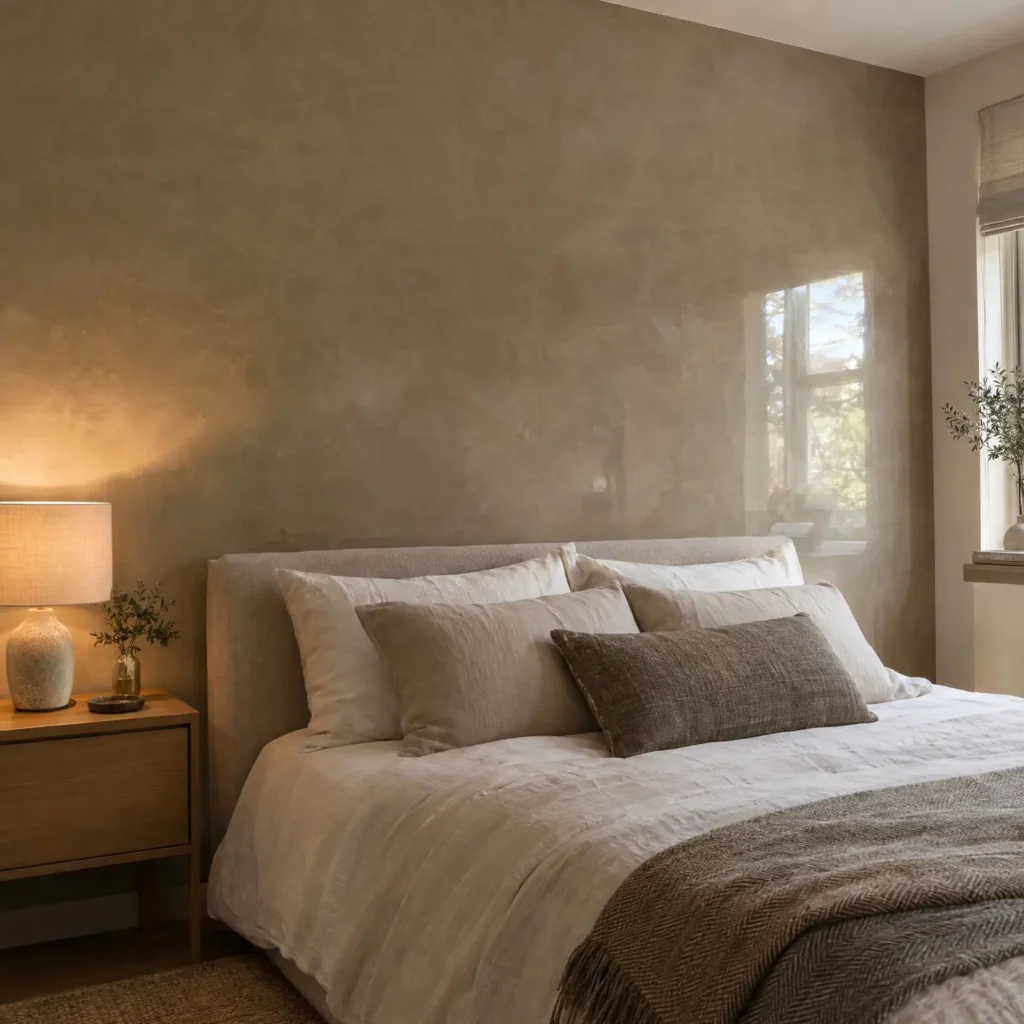
We apply polished plaster across Ireland
Bellart Decor applies polished marble, Marmorino and Travertino across Ireland from Kilcullen, Co. Kildare. 20+ years of decorative finishes, and the same craftsman on your wall from the first day to handover.
Preparation is most of that: filling, sanding, a skim coat where the wall needs one, then the right primer.
2 or 3 year warranty.
Read more +
White or off-white, cool grey or warm, gloss or satin: none of those should be decided off a screen. Tell us the wall and we will panel it.
What does polished plaster cost?
Polished plaster sits at the top of the three Venetian plaster finishes because it takes the most layers and the most burnishing: the material cost barely differs from Marmorino, the hours do. The price follows the area, the flatness of the wall and whether it is a ceiling or a curve. We price after we have seen the wall, with any preparation or skim coat as a separate line. For the full breakdown, and what a cheap quote leaves out, see our Venetian plaster cost page.
Venetian plaster cost →Cleaning, re-polishing and repairs
Soft dry cloth for dust, barely damp cloth for marks, dried off. On a dark polish, work in one direction and dry it or you will leave smears. Never vinegar, lemon, limescale remover, bleach or an abrasive pad: on a gloss finish a splash of limescale remover etches a dull patch in seconds that only re-burnishing will fix.
A wall that has gone dull with age can be re-burnished rather than replaced, which is something no paint and no wallpaper offers.
A patch in a mirror finish will usually be visible at some angle, so where a wall is badly marked we redo the panel to the nearest corner rather than leave a repair you can find. That is exactly why we put Marmorino in busy spaces.
Polished plaster questions
?
What is Venetian polished plaster?
A lime plaster made with finely ground marble, applied in several thin hand-trowelled layers and burnished until the surface reflects. The sheen comes from compressing the material, not from a varnish. Total thickness is under 2 mm.
?
Is polished plaster the same as stucco veneziano?
Yes. "Stucco veneziano" is the Italian name for the high-sheen lime finish, and "polished plaster" is what the Irish and British trade calls it.
?
Can you get white Venetian plaster?
Yes, and it is the most requested colour. Lime is naturally off-white, so a true cold white needs pigment that can take depth out of the finish. Most people who compare the two on one panel choose the warm off-white, and it still reads as white on the wall.
?
Can polished plaster be done in grey?
Yes. Grey is the second most requested colour and it reads like honed marble. A grey with some warmth in it holds up better in average Irish light than a cool grey.
?
Does polished plaster scratch?
It can, like any lime surface, but the colour runs all the way through, so a scratch does not flash white the way damaged paint does. Light scuffs come off with a damp cloth. Deeper damage is dealt with by re-burnishing the panel rather than patching it.
?
How many coats of polished plaster are needed?
More than any other finish in the family: several thin layers rather than the two or three a matte Marmorino takes, each burnished before the next. The layer count is why the price sits above the matte finishes.
?
Will polished plaster show the joints in my plasterboard?
Only if they are not filled properly first. A gloss finish will show a taped joint, a screw head or a bulge that matte paint hides, which is why we check the wall with a straight edge before quoting and price a skim coat in where it is needed.
?
Is polished plaster better than marble-effect wall panels?
For a seamless look, yes: there is no joint every metre and no fixing detail, and the sheen is in the material. Panels are quicker to fit and easier to replace. If you want a continuous polished surface, with depth rather than a printed pattern, polished plaster is the stronger choice.
?
Can polished plaster be used in a bathroom?
On walls and ceilings outside the direct spray of the shower, yes, waxed. Steam is fine; standing water is not. Inside a shower enclosure we use microcement over tanking instead.
?
How much does polished plaster cost?
It sits at the top of the three Venetian plaster finishes because it takes the most layers and the most burnishing. We quote after seeing the wall, with preparation and any skim coat as separate lines. See our Venetian plaster cost page.
Other plaster finishes and rooms
Sample panel
See the finish on your own wall before you commit
Tell us the room and the look you are after. You get a sample panel in your colour and an itemised quote.